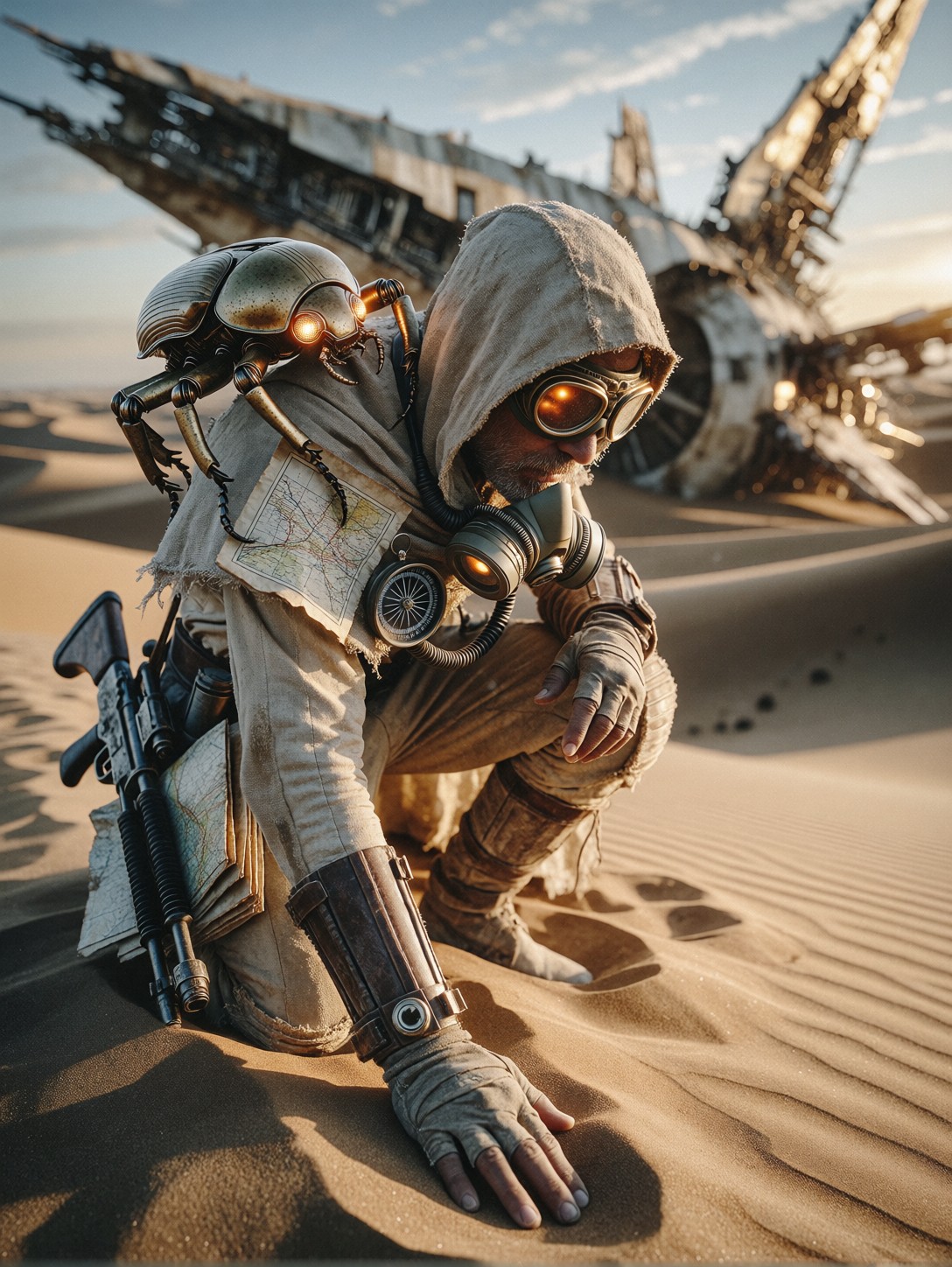

Brass Mechanics Against Sun-Baked Linen
The articulated brass legs of a mechanical scarab resting against wind-scoured linen create an immediate tension between ancient survival and forgotten technology. Proxima Aurelia 2 reads the kneeling posture and desert geography as a narrative canvas rather than a simple backdrop. Warm golden light sculpts the tracker’s stubble and tattered cloak, while long shadows stretch across the dunes to emphasize vast emptiness. The shallow depth of field isolates the character and his mechanical companion, letting the skeletal starship in the distance read as environmental storytelling rather than cluttered detail. Every texture—from oxidized brass to dust-caked skin—carries weight, turning a single moment into a complete story beat.
Pitch-Ready Concept Art and World-Building Assets
Concept artists, game developers, and novelists will find immediate value in this setup for character sheets, cover illustrations, or environmental pitch materials. The prompt’s cinematic wide framing naturally leans toward a 16:9 or 15:10 aspect ratio to capture both the foreground detail and the crashed starship without compressing the horizon. Because Aurelia prioritizes atmospheric composition over fine typographic rendering, this works best for visual development rather than logo-heavy commercial mockups.
Settings for Proxima Aurelia 2 — Balancing Atmosphere and Detail
Aurelia 2 thrives on intelligent framing and rich storytelling, so guiding the model with moderate constraints keeps its compositional instincts intact without forcing unnatural lighting or warped anatomy.
- CFG / Guidance:
3.0–3.5— prevents over-saturation in the golden hour tones while preserving deep shadow detail - Steps: 24–30 for full cinematic rendering and mechanical joint clarity; 12 steps only for quick composition checks
- Resolution:
1536×864or1344×960— wide formats preserve the desert vista and starship scale without stretching anatomy
Aurelia’s strength lies in reading spatial relationships natively. Keep guidance moderate and let the model handle the atmospheric blending—pushing it higher will harden shadows and flatten the dunes.
Applying the Midjourney-Style Rendering LoRA
Running Midjourney-Style Rendering at 0.75 pushes the output toward that polished, high-fidelity cinematic look. Weights in the 70–85 range work best here—high enough to override the base model’s default softness and inject sharp contrast, but low enough to preserve Aurelia’s natural skin tones and environmental depth. If you want a slightly grittier, less retouched aesthetic, drop the LoRA to 0.60 and rely on the native Flux architecture for organic texture.
Shifting the Environment and Era for New Story Beats
5 Targeted Variations for This Scene
- Cold-weather survival: Replace "sun-baked dunes" with "frozen obsidian plain at twilight" — cold blue ambient light replaces golden hour, turning the scarab’s amber glow into the sole heat source
- Vertical scale shift: Swap the starship wreckage for a derelict orbital elevator — shifts scale from planetary survival to high-altitude scavenging, adding atmospheric haze and vertical composition lines
- Biopunk texture swap: Replace the mechanical scarab with a bio-engineered sand-strider — trades brass mechanics for chitinous organic detail, leaning into biopunk aesthetics while keeping the warm desert palette
- Dynamic weather injection: Add "sudden sandstorm on the horizon, airborne particulate, motion blur" — forces tighter focus on the character’s grip and the scarab’s glowing eyes amid the chaos
- Cultural reframe: Change "tattered hooded cloak" to "woven kilim poncho, brass filigree goggles, leather-bound astrolabe" — shifts the setting from generic sci-fi to a sun-bleached desert civilization with distinct regional tailoring
Two Prompts Ready to Generate
Apply two of the variations above directly — both are tuned for Proxima Aurelia 2 at the settings recommended above.
Variation: frozen obsidian plain at twilight — cold blue ambient light replaces golden hour, turning the scarab’s amber glow into the sole heat source
Cinematic wide shot of a weathered tracker kneeling on a frozen obsidian plain at twilight, one hand pressed to the black glass. He wears a tattered hooded cloak of sand-colored linen, goggles pushed up onto his forehead, and a respirator mask hanging around his neck. On his shoulder rests a mechanical scarab beetle with glowing amber eyes and articulated brass legs. Behind him stretches an endless expanse of jagged ice formations, interrupted by the skeletal remains of a colossal crashed starship. Warm blue ambient light, magenta sky gradients, long shadows, shallow depth of field, highly detailed mechanical parts, cinematic lighting
Variation: bio-engineered sand-strider — trades brass mechanics for chitinous organic detail, leaning into biopunk aesthetics while keeping the warm desert palette
Sci-fi character design shot of a weathered tracker kneeling on sun-baked dunes at sunrise, hand resting on hot sand. He wears a tattered hooded cloak of sand-colored linen, goggles pushed up onto his forehead, and a respirator mask hanging around his neck. On his shoulder rests a bio-engineered sand-strider with chitinous plates and pulsing bioluminescent veins. Behind him stretches an endless sea of dunes, interrupted by the skeletal remains of a colossal crashed starship. A compass and worn maps are tucked into his belt, along with a tubular energy rifle. His expression is focused and calm, reading the wind and sand. Warm golden light, long shadows, vast emptiness. Realistic skin texture with dust and stubble, fine organic details on the strider, warm dusty tones, cinematic wide shot, shallow depth of field
More Prompts Exploring Cinematic Sci-Fi Framing
If you enjoy blending environmental scale with tightly focused character moments, these prompts explore similar narrative framing across different sci-fi aesthetics: