One Figure, One Canvas, and the Geometry of Silence
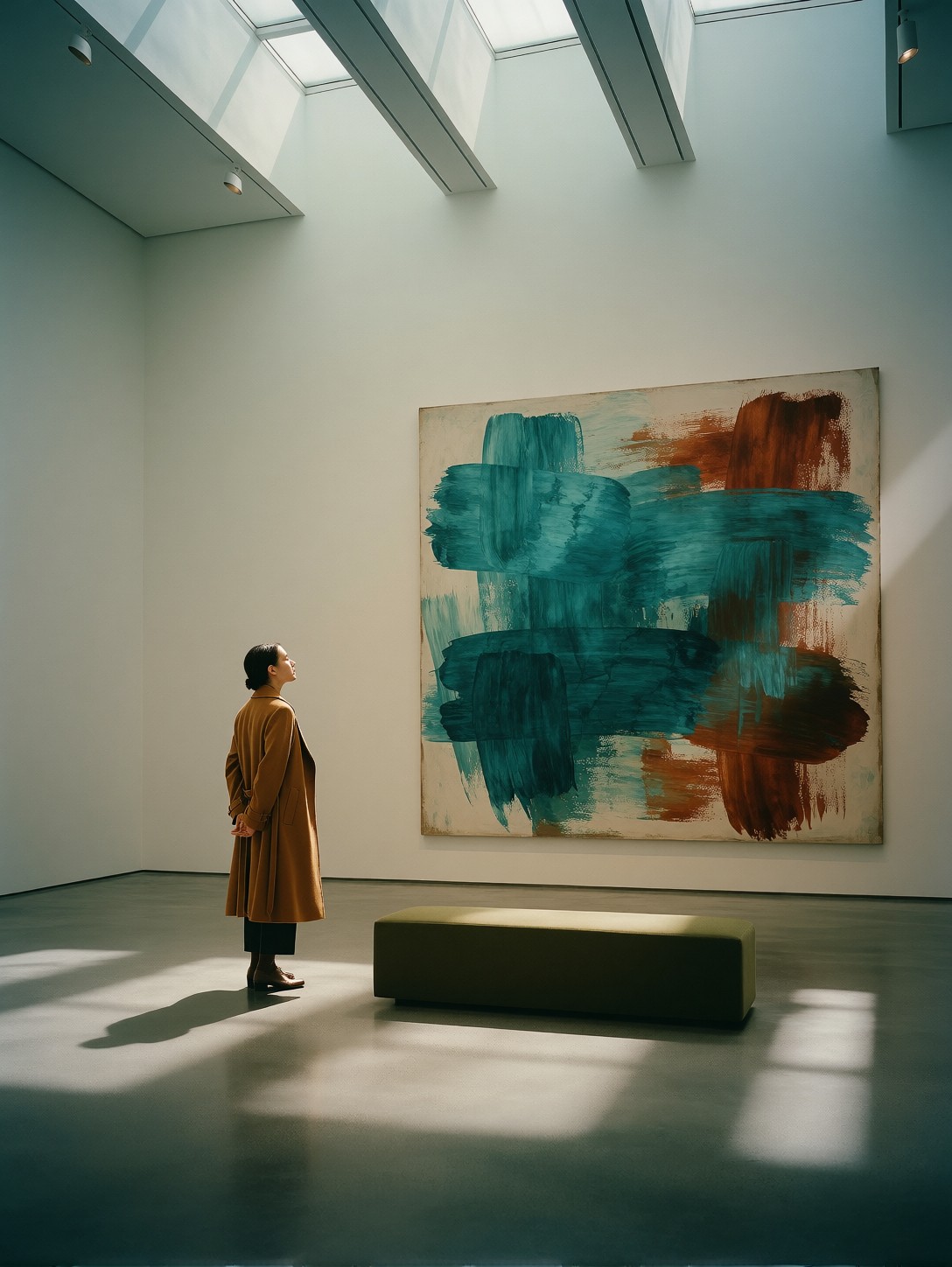
The strongest choice here is restraint: a single visitor, a single painting, and a floor doing most of the compositional work. Long soft shadows stretch diagonally across polished concrete while the ochre trench coat becomes the only warm note in a room built from gallery white, deep teal, and soft gray. Proxima Aurelia 2 thrives on exactly this kind of visual storytelling — it reads "hands clasped behind her back, head tilted" as narrative, not just pose, and renders contemplation as something you can feel.
The massive turquoise-and-sienna canvas anchors the eye, but it is the skylight daylight that gives the image its life: directional, soft, museum-clean. Shot at eye level with a 35mm lens, the framing keeps the viewer at the same height as the visitor — you are standing in the hall with her, not observing from above.
Where This Kind of Image Earns Its Keep
Architecture studios and interior designers use this exact aesthetic for portfolio mood boards — it communicates taste without shouting. It also suits editorial features on art and culture, minimalist print posters, and website hero imagery for galleries or creative agencies.
The wide, eye-level framing works best in 3:2 or 16:9 landscape — try 1664×928 for cinematic crops. Portrait orientation will fight the horizontal shadow lines and compress the canvas into the frame edge. One honest limitation: don't expect legible artwork details on the abstract canvas — it stays painterly, which is the point.
Getting the Settings Right in Proxima Aurelia 2
Aurelia 2 builds on Flux Schnell architecture, so guidance behaves the way Flux users expect — and its strength in intelligent composition means you can keep prompts lean and trust the model with arrangement.
- CFG / Guidance:
3.0–3.5— high enough to hold the muted palette, low enough to keep daylight soft rather than blown out - Steps: 30 for final quality; 12 for fast composition previews
- Resolution:
1664×928(16:9) or1216×832(3:2) for landscape editorial work
Keep "muted palette" in the prompt even when everything else changes — Aurelia 2 respects colour direction strongly, and dropping it tends to produce oversaturated gallery whites.
Because the model handles storytelling from simple prompts, resist over-specifying: the coat colour, the bench, and the light direction are enough. Extra adjectives dilute rather than improve.
Five Ways to Rethink the Gallery Scene
Targeted Variations for This Museum Composition
- Flip the time of day: Replace "soft directional daylight" with "golden hour light raking through tall west windows" — shadows lengthen and warm, the white walls pick up honey tones
- Change the art: Swap the "abstract canvas of turquoise and burnt sienna" for "a monumental black-and-white photograph" — the scene shifts from painterly to documentary, and the coat becomes the only colour in frame
- Add a second figure: Introduce "a child pointing up at the canvas" — instantly transforms quiet contemplation into narrative tension and gives Aurelia 2 a story to render
- Go nocturnal: Change daylight to "after-hours gallery lit only by track spotlights" — the mood turns intimate and slightly mysterious, ideal for moody editorial covers
- Reframe vertical: Add "low-angle shot, soaring skylight grid visible, 3:4 portrait" — trades the floor shadows for architectural drama, perfect for magazine covers
Two Prompts Ready to Generate
Both examples below apply variations from the list above — tuned for Aurelia 2 at the recommended landscape settings.
Variation: golden hour — daylight warms and lengthens, turning the white hall into late-afternoon amber
Minimalist white museum hall, polished concrete floors, golden hour light raking through tall west windows. A solitary visitor in a tailored ochre trench coat stands before a massive abstract canvas of turquoise and burnt sienna brushstrokes, hands clasped behind her back, head tilted in contemplation. Long amber shadows stretch across the floor, single olive-green bench. Muted palette, shot on 35mm, eye-level wide framing, serene mood, ultra sharp, 8k.
Variation: second figure — a child pointing at the canvas adds narrative warmth to the quiet hall
Minimalist white museum hall, polished concrete floors, skylights casting soft directional daylight. A woman in a tailored ochre trench coat stands before a massive abstract canvas of layered turquoise and burnt sienna brushstrokes; a small child beside her points up at the painting. Long soft shadows on the floor, olive-green bench anchoring the composition. Muted palette of gallery white, warm ochre, deep teal. 35mm lens, eye-level wide framing, serene storytelling mood, ultra sharp, 8k.
More Quiet, Compositional Scenes Like This
If the muted-palette, single-subject approach appeals to you, these prompts explore similar territory — texture, contemplation, and restrained colour: