Paint as Terrain: Impasto Texture Meets Raking Gallery Light
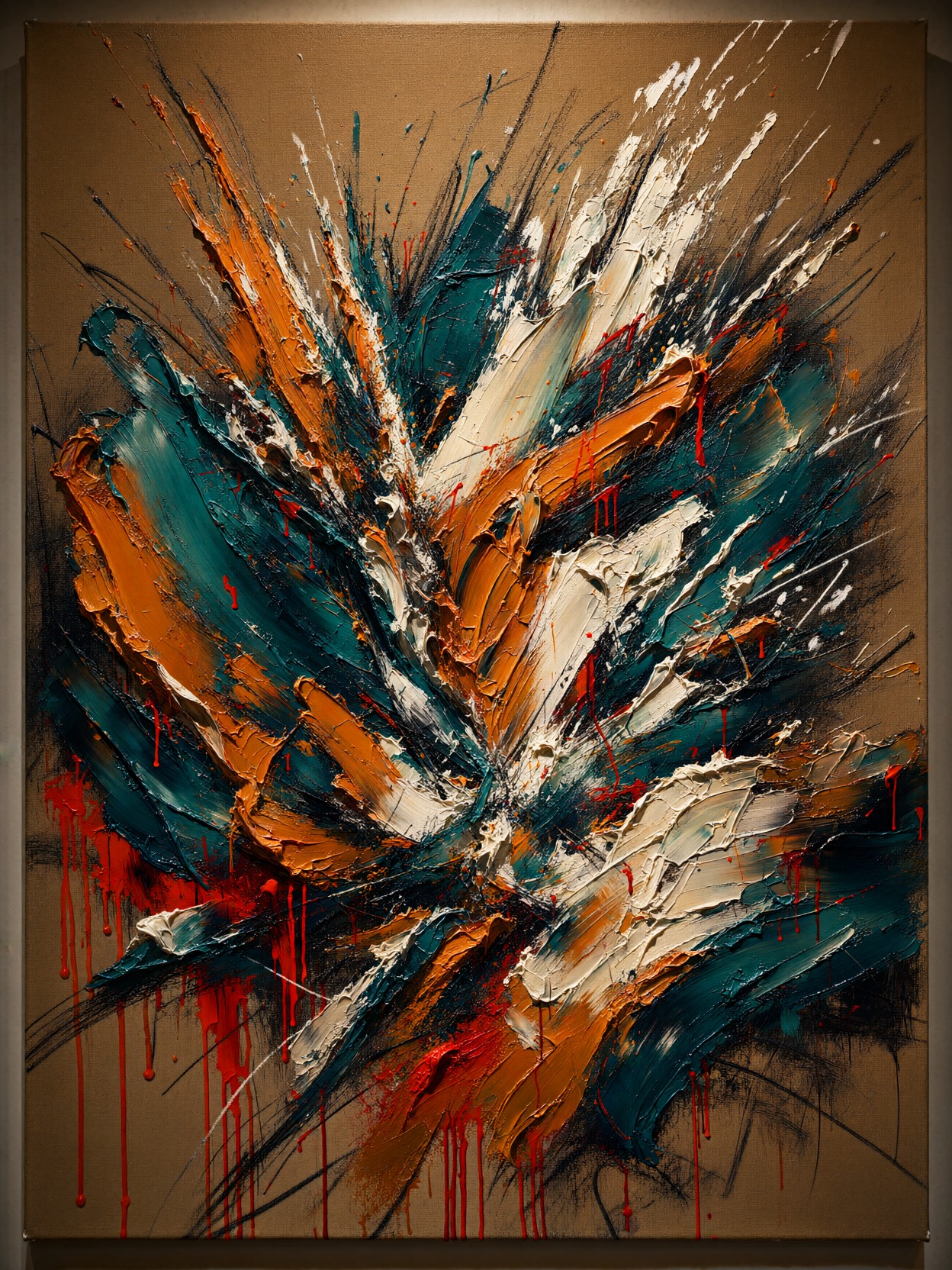
The detail that makes this prompt sing is the raking light — light angled across the surface so every impasto ridge throws its own tiny shadow. That single instruction turns a flat image into something that reads as physical paint, and Qwen 2.1's fine-detail rendering is exactly the kind of engine that exploits it.
The composition is deliberately split: heavy palette knife swaths anchor the lower third in teal and bone white, while flicked bristle marks burst upward like a storm front. Dripping cadmium red rivulets cut through vertically, and scratched charcoal lines add raw, aggressive punctuation. Chaos is the goal — but the prompt's phrase "chaotic yet balanced" is what keeps the model from producing pure noise. Visible canvas weave in raw umber grounds everything.
Where This Kind of Canvas Belongs
Large-format wall art is the obvious home — abstract expressionist prints sell, and this palette (deep teal, burnt orange, bone white) suits modern interiors and moody office spaces alike. It also works as album or book cover art where emotional intensity matters more than literal imagery, and as texture overlays for designers compositing paint surfaces into other work.
Go 3:4 portrait at 1080×1440 for gallery-style presentation, or 16:9 for a wide statement piece above a sofa. Square crops also work well here — gestural abstraction tolerates them better than figurative prompts do.
Qwen 2.1 Settings for Maximum Paint Texture
Qwen 2.1's native 2K output is a genuine advantage for this prompt — impasto ridges and canvas weave live or die on resolution, and lower-res models smear them into generic "painting" texture.
- CFG / guidance:
3.5— enough adherence to keep the palette locked to teal/orange/white without flattening the gesture - Steps: 30 for final quality; 12 for fast composition previews
- Resolution:
1080×1440(3:4) or1664×928(16:9); upscale from native 2K for print
If the drips come out too neat and uniform, add "irregular drip velocity, varying thickness" — models love to regularize liquids unless told otherwise.
Five Ways to Push the Canvas Further
5 Targeted Variations for This Abstract Expressionist Painting
- Shift the palette temperature: Swap "deep teal, burnt orange" for "ochre, oxide red, and charcoal black" — the mood moves from stormy-modern to earthy and ancient
- Change the gesture: Replace "palette knife swaths dominate" with "wet-into-wet washes dominate, palette knife only in the corners" — softer Rothko-like atmosphere replaces the violence
- Introduce a figure: Add "a single silhouetted figure dissolving into the paint in the upper third" — the abstraction gains narrative tension without losing its gestural character
- Cold night version: Change "moody gallery lighting" to "cold blue gallery spotlights, wet reflective varnish" — the ridges gleam instead of casting warm shadows
- Scale contrast: Add "one vast calm field of bone white occupying half the canvas, violence compressed into the other half" — dramatic negative space makes the chaos hit harder
Two Prompts Ready to Generate
Both examples below apply variations from the list above, tuned for Qwen 2.1 at the settings recommended earlier.
Variation: cold night version — gallery warmth replaced by blue spotlights and wet varnish, so the ridges gleam rather than shadow
Abstract Expressionism, gestural oil painting. Violent collision of thick impasto strokes in deep teal, burnt orange, and bone white on raw umber canvas, dripping cadmium red rivulets, scratched charcoal lines. Palette knife swaths in the lower third, flicked bristle marks exploding upward. Cold blue gallery spotlights, wet reflective varnish catching highlights on paint ridges. Visible canvas weave, chaotic yet balanced, highly detailed, 8k
Variation: scale contrast — half the canvas held calm in bone white, the gestural violence compressed into the other half for maximum impact
Abstract Expressionism, gestural oil painting. One vast calm field of bone white impasto occupying half the canvas; the other half a violent collision of teal, burnt orange, and cadmium red — palette knife swaths, dripping rivulets, scratched charcoal lines tearing across the boundary. Raw umber canvas weave visible, moody raking gallery light across the ridges, chaotic yet balanced, highly detailed, 8k
More Abstract and Textured Canvases
These prompts explore the same territory from neighboring angles — molten metallic swirls, neon-lit figure work, and other gestural abstract canvases: