

Scales, Steam, and a Single Shaft of Sunlight: Anatomy of a Lamia Portrait
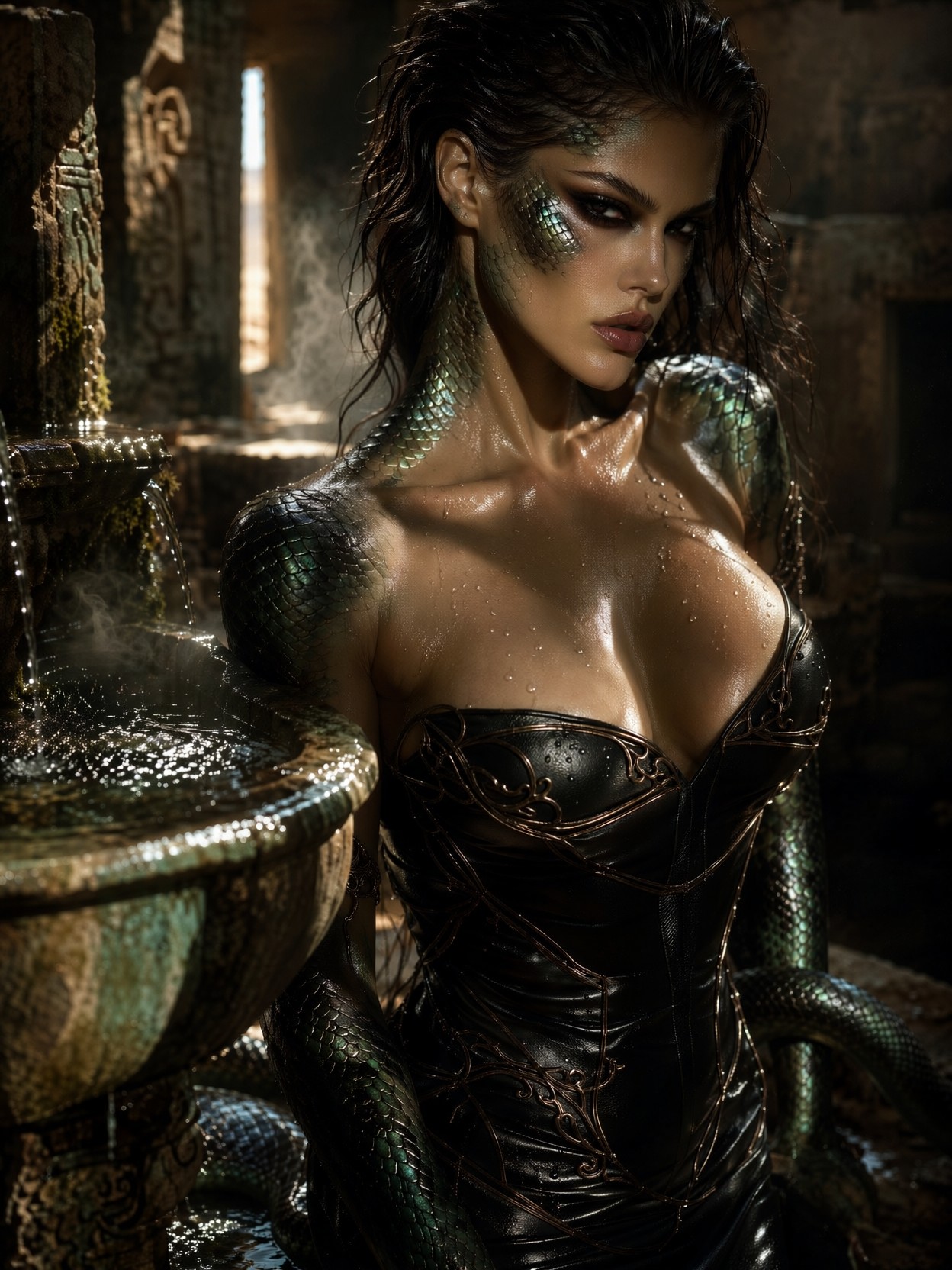
The most dangerous detail in this image is also the smallest — iridescent emerald scales scattered across cheekbones and collarbones like a secret the skin is trying to keep. Everything else supports that single point of transformation: a crumbling Libyan tomb, a moss-covered fountain leaving glistening micro-droplets on polished serpent leather, and warm, low-angled sunlight slicing through a narrow window to ignite rising steam.
Qwen 2.1 is unusually well suited to this balancing act. Its lifelike portrait lighting handles the chiaroscuro contrast — deep shadow against glowing highlight — while its fine-detail rendering resolves the hyper-real skin pores, metallic bronze patina, and textured leather that make the "myth made flesh" illusion convincing. The Hasselblad camera language anchors the whole thing in editorial photography rather than illustration.
Dark Editorial, Book Covers, and Mythology Reimagined
Beauty-and-monster fusion portraits like this land naturally in several places: dark fantasy book covers, mythological retelling marketing, high-fashion editorial concepts, and character art for tabletop or video game campaigns. The serpent-woman archetype — Lamia specifically — gives it narrative weight a generic fantasy portrait lacks.
Stick with 3:4 portrait orientation at 1080×1440 or native 2K. The tall window, rising steam, and vertical figure all reward vertical framing; a landscape crop would gut the light-shaft composition that carries the drama.
Qwen 2.1 Settings for Wet Skin and Bronze Patina
Qwen 2.1's native 2K output means you can generate at 1664×2496 territory without upscaling artifacts — valuable when the whole concept depends on micro-texture like droplets and pores.
- CFG / Guidance:
3.5— enough adherence to keep the scales exactly on cheekbones and collarbones, not smeared across the face - Steps: 30 for final quality — wet-skin specular highlights need the extra refinement; 12 for composition previews
- Resolution:
1080×1440(3:4) standard, native 2K for print - Typography bonus: if you need a title on the image, Qwen 2.1 renders crisp text — add something like "engraved bronze plaque reading LAMIA" and it will hold
Keep "low-angled sunlight through a narrow window" verbatim — it is the sentence doing the chiaroscuro work. Vague lighting words like "dramatic" alone will flatten the scene.
Managing Three Heavy LoRAs
All three of these styles sit above the 0.65 mark, which is dominant territory — they will fight each other unless you rebalance deliberately.
- GPT style at
0.95— this is the lead voice: gilded, iridescent, cinematic glow. It will amplify the emerald scales beautifully, but watch for it gilding the tomb stone into fantasy palace territory - Grim Dark Glamour 80s at
0.75— brings the shimmering silver and high-fashion edge that suits the serpent-leather gown; this is your bridge LoRA between celestial glow and dark glamour - Dark Glamour 80s at
0.65— largely overlaps with Grim Dark Glamour; running both at these weights risks pastel wash-out on a scene that should be moody bronze and shadow
Recommendation: drop Dark Glamour 80s to 0.30–0.40 so it only contributes glossy makeup and hair polish, or remove it entirely and let the two stronger LoRAs define the look. If the tomb loses its darkness, also pull GPT style back toward 0.70.
Five Ways to Push the Lamia Portrait Further
5 Targeted Variations for This Serpent-Woman Scene
- Shift the myth: Replace "Lamia" with "Medusa" and change scales to "serpent hair, one strand coiling across her jaw" — the danger moves from skin to gaze, and you can add "averted eyes, tense expression" for narrative tension
- Cool the palette: Change "warm, low-angled sunlight" to "cold blue moonlight through the window, silver steam" — the same tomb becomes nocturnal and colder, and the emerald scales glow harder against blue
- Amplify the serpent: Add "a massive dark serpent coiled around the fountain base, scales matching hers" — introduces a second scale-texture zone and doubles the mythological threat
- Editorial reframe: Swap the tomb for "flooded Roman bathhouse, sunken marble columns" — keeps water, stone, and steam but moves the setting from Libyan to classical Mediterranean glamour
- Push the fashion: Change the gown to "backless gown, bronze filigree spine-piece" and add "full-body shot, 3:4" — the LoRAs' 80s glamour DNA shines hardest on runway-style posing
Two Prompts Ready to Generate
Both examples below apply variations from the list above, tuned for Qwen 2.1 at the settings recommended earlier.
Variation: cold moonlight shift — the tomb turns nocturnal, moonlight replaces sun, and the emerald scales become the brightest element in frame
Photorealistic dark mythological portrait of a beautiful young woman with predatory dark eyes and iridescent emerald-green scales on her cheekbones and collarbones, standing in a crumbling ancient Libyan tomb. Cold blue moonlight through a narrow window, silver steam rising, wet stone glistening. Black serpent-leather gown with oxidized bronze filigree, micro-droplets on skin, moody chiaroscuro, cinematic film texture, shot on Hasselblad, 8k
Variation: editorial reframe — same serpent-woman moved to a flooded Roman bathhouse, trading tomb dread for classical glamour
Photorealistic portrait of a beautiful young woman with subtle emerald-green scales across her cheekbones and shoulders, standing in a flooded Roman bathhouse with sunken marble columns. Warm low sunlight through a high arch, steam rising off the water, glistening droplets on her skin and black serpent-leather gown with bronze filigree. Dark wet hair swept back, moody chiaroscuro lighting, cinematic film texture, Hasselblad 85mm f/1.4, 8k, 3:4
More Dark Portraits in This Direction
These prompts explore the same dark-myth portrait territory — warrior women, masks, and moody atmospheric lighting: