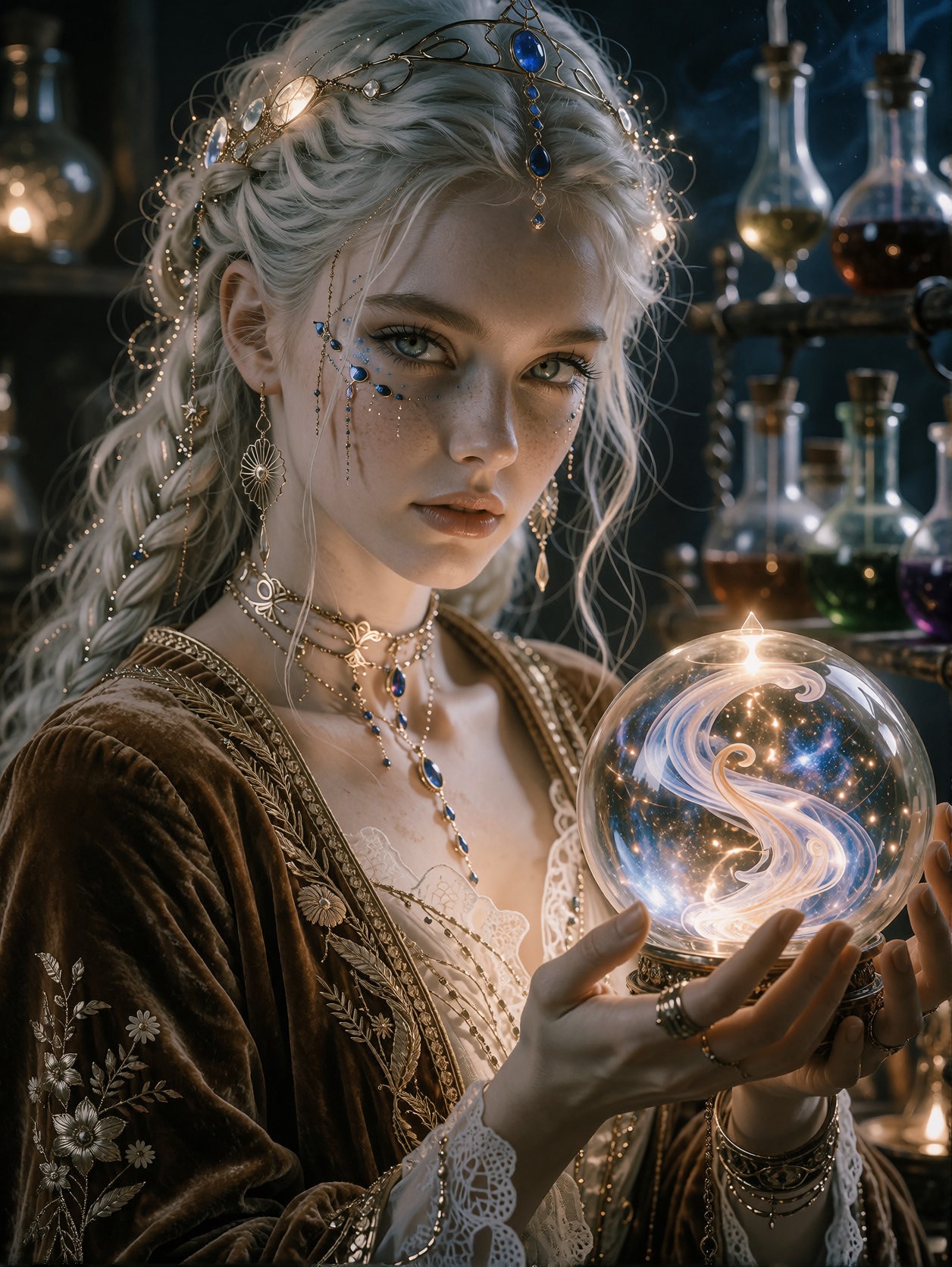


Resolving the Impossible: From Digital Blur to Alchemical Detail
The tension between the soft, swirling nebulas within a glass orb and the crisp, microscopic definition of a velvet robe is what makes this image so arresting. Krea 2, in this specific configuration, is tasked not just with painting a scene, but with performing a feat of digital restoration—pulling every single micro-texture into sharp, hyper-detailed focus. The delicate gold embroidery against the deep velvet isn't just visible; it feels tactile, just as the natural pores on the enchantress's skin are resolved.
This is a masterful exercise in controlled lighting. The magical ambient glow acts as a directional key light, preventing the dimly lit alchemist workshop from sinking into complete shadow. Instead, the contrast is managed by the glowing orb, which serves as a focal point, illuminating the enchantress's face and creating a vibrant bokeh of colorful potion bottles in the background 🔮. The resulting image is a high-contrast fusion of scientific precision and arcane mystery.
Character Concept Art and High-Fidelity Digital Illustration
If your project demands visual quality that transcends standard stock art, this prompt is invaluable. This level of detail—combining perfect skin resolution with complex material rendering like gold embroidery and glass nebulas—is perfect for:
- Character sheets for high-budget RPG video games (e.g., Souls-like or high-fantasy CRPGs).
- High-end book cover art for epic fantasy or dark magic novels.
- Digital portfolio pieces requiring photorealistic texture mapping and lighting studies.
- Marketing or promotional material for complex, lore-heavy fictional universes.
We recommend maintaining a portrait orientation to best showcase the close-up detail and the vertical flow of the magical glow. For maximum impact, push the resolution beyond standard HD to truly utilize Krea 2's capabilities.
Settings for Krea 2 — Mastering Aesthetic Blending
Krea 2 is celebrated for its intelligent style blending, meaning the synergy between your LoRAs is more important than any single parameter. The key here is managing the "clash" between the celestial opulence of the GPT style and the nostalgic grit of Horror 1980x.
- Aesthetic Blend: Since the LoRAs are already weighted, start with the prompt structure as is. The model's strength is in merging these disparate styles without them canceling each other out.
- CFG/Guidance Scale: Aim for a medium-high guidance scale (around
7–9) to ensure the model stays true to the complex instructions like "micro-textures" and "nebulas," without over-saturating the lighting. - Steps: Use a high step count (30+) to allow the model sufficient time to resolve the complex interactions between the velvet, the gold, and the light scattering off the glass orb.
Balancing the LoRA Fusion
The blend of these three LoRAs is ambitious. The Ethereal Dark Fantasy Painting provides the mood, GPT style provides the luxury, and Horror 1980x provides the eerie texture and grain.
Try reducing the weight of 'Horror 1980x' to around 20. This allows the 80s VHS grain to feel like intentional atmospheric grit, rather than overpowering the delicate gold and celestial elements.
Five Ways to Push the Alchemist's Portrait Further
5 Targeted Variations for This Prompt
- Shift the setting's focus: Replace "alchemist workshop" with "clockwork mechanism of a celestial observatory" — changes the mechanical/magical aesthetic, trading bubbling potions for brass gears and star charts.
- Swap the light source: Change "magical ambient glow" to "flickering firelight reflecting off tarnished silver" — grounds the magic in a more tangible, grounded reality, emphasizing the 'dark' side of the prompt.
- Change the subject's interaction: Instead of holding an orb, change to "her hand resting on a complex, glowing runic tablet" — moves the focus from an object of power to an object of study/lore.
- Lean into the 'Horror' LoRA: Double the weight of
Horror 1980xand swap "velvet robe" for "distressed, heavy leather scholar's attire" — pushes the character into a gothic horror archetype. - Formalize the composition: Change "close-up portrait" to "three-quarter body view, dynamic pose, stepping out of the workshop shadow" — introduces action and environment, moving away from the static portrait format.
Two Prompts Ready to Generate
These examples utilize the specific LoRA weights and focus on the textural contrasts described in the prompt, applying two different thematic shifts.
Variation: Industrial Alchemy — replacing magical glow with harsh, functional light to give the piece a Cyberpunk/Gothic Tech feel
HD detail restoration, high-definition image enhancement. A crisp, high-resolution close-up portrait of a young enchantress in a dimly lit clockwork observatory. Fine micro-textures: delicate gold embroidery on velvet robe, natural skin pores, and tiny swirling nebulas inside a glass orb. Harsh, clinical neon light illuminating her face, high contrast, crystal-clear background bokeh of brass gears and intricate machinery, photorealistic, ultra-detailed, 8k resolution.
Variation: Eerie Scholar — emphasizing the 'Horror' LoRA by changing the clothing and environment to reflect a distressed, gothic scholar
HD detail restoration, high-definition image enhancement. A crisp, high-resolution close-up portrait of a young, gaunt scholar in a crumbling Victorian library. Fine micro-textures: distressed heavy leather scholar's attire, deep wrinkles, and swirling cosmic dust in an antique brass telescope. Dimly lit by a single flickering gaslight, extreme high contrast, vintage cinematic grain, photorealistic, ultra-detailed, 8k resolution.
Related Prompts in High-Fidelity Visual Storytelling
If you enjoyed the detailed rendering and atmospheric depth of this portrait, these related concepts explore different facets of epic fantasy and dramatic lighting:


