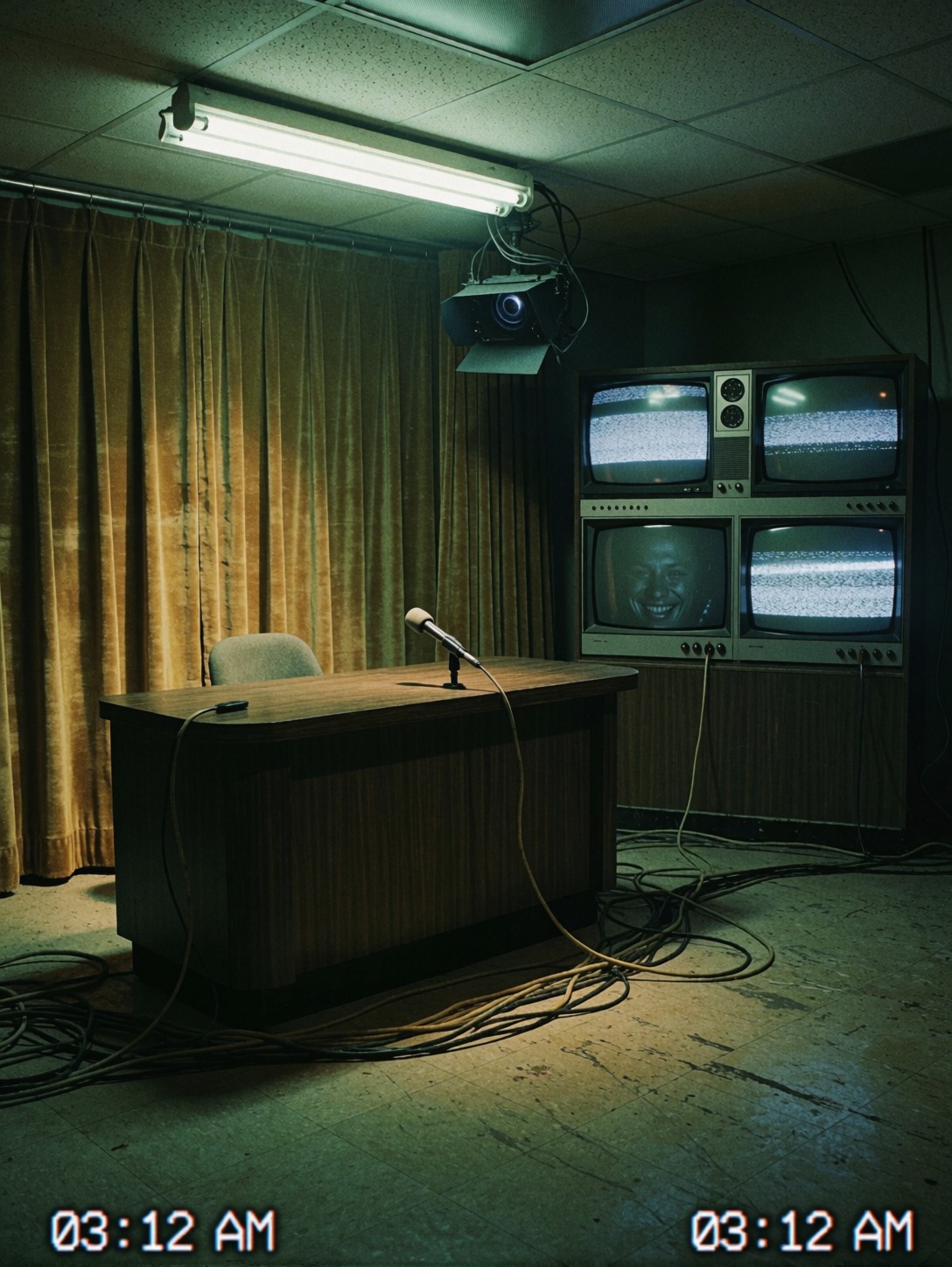
One Lit Screen, One Wide Smile: Anatomy of an Analog Horror Scene
The scariest detail in this prompt is also the smallest: out of four CRT monitors, only one is showing anything — and what it shows is a face that's smiling too widely, barely there in the darkness. Everything else in the scene conspires to sell that moment. The buzzing fluorescent tube, the half-drawn mustard velour curtain, the cables snaking across scuffed linoleum — these are the props of a dead TV station at 3 AM, rendered in greenish-yellow decay.
Proxima Aurelia 2 handles the layered degradation beautifully: scanlines, chromatic aberration, and tracking distortion along the bottom edge stack into a convincing VHS artifact field, while the 03:12 AM timestamp anchors the found-footage illusion. The model's strength in visual storytelling means the composition reads as a still frame from a tape you were never supposed to find.
Found-Footage Feeds, Thumbnails, and ARG Material
This kind of image is built for horror storytelling formats. YouTube analog horror series (think local-broadcast creepypasta), ARG promotional material, creepypasta illustrations, and streaming-platform thumbnails all thrive on this 1980s broadcast aesthetic. It also works as atmosphere art for tabletop horror campaigns or album covers in the dark synth and hauntology space.
Stick with 16:9 — the wide frame mimics a real TV broadcast and gives the monitor bank room to breathe. Vertical crops break the illusion, because nobody taped their TV in portrait mode.
Dialing In Proxima Aurelia 2 for VHS Decay
Aurelia 2 reads even simple prompts with strong compositional intelligence, so resist the urge to over-describe. The artifact keywords do the heavy lifting — let them.
- CFG / Guidance:
3.0–3.5— higher values push the smile into cartoon territory and harden the fluorescent lighting - Steps: 30 for maximum texture fidelity — heavy grain and scanlines need steps to resolve cleanly; 12 works for composition previews
- Resolution:
1664×928(16:9) — broadcast-native framing; upscale to1920×1080for video thumbnails
Paradoxically, the face works better when barely described. "Faint, too-wide smiling face" outperforms detailed facial descriptions — the ambiguity is the horror.
Five Ways to Push the Broadcast Deeper Into Dread
5 Targeted Variations for This Analog Horror Prompt
- Flip the screens: Change "static except one" to "all four screens show the same face at different zoom levels" — repetition replaces mystery with escalation
- Move the timestamp: Swap "03:12 AM" for "timestamp corrupted, digits melting sideways" — the tape itself becomes unreliable
- Empty the room further: Replace the desk setup with "rows of empty folding chairs facing the monitors" — an audience-less screening implies someone expected to be there
- Shift the era: Change the studio to "a 1990s school AV room, projector humming" — same grammar, different nostalgia trigger
- Give the face company: Add "a faint silhouette reflected in the dark monitor glass" — layering a second presence doubles the unease without showing more
Two Prompts Ready to Generate
Both examples below apply variations from the list above, tuned for Aurelia 2 at the recommended settings.
Variation: escalation on the screens — all four monitors show the same face at different zooms, turning mystery into inevitability
Analog Horror, VHS grain aesthetic. Dim 1980s public access TV studio at night, empty host's desk, flickering fluorescent tube, faded mustard velour curtain. Four CRT monitors all display the same faint too-wide smiling face at different zoom levels. Tangled cables on scuffed linoleum, greenish-yellow tint, heavy scanlines, chromatic aberration, tracking distortion, timestamp 03:12 AM, cold found-footage mood, highly detailed, 8k
Variation: corrupted timestamp — the tape itself becomes unreliable, with melting digits and a second presence in the monitor glass
Analog Horror, VHS grain aesthetic. Dim 1980s public access TV studio late at night, empty host's desk under a buzzing flickering fluorescent tube, half-drawn mustard velour curtain. One CRT monitor shows a faint too-wide smiling face in darkness, a faint silhouette reflected in the glass. Timestamp corrupted, digits melting sideways. Greenish-yellow tint, heavy scanlines, chromatic aberration, tracking distortion along bottom edge, cold uneasy found-footage mood, highly detailed, 8k
More Analog Horror From the Same Tape Shelf
These prompts share the same surveillance-and-quiet-wrongness DNA — abandoned spaces, figures that shouldn't be there, dread delivered through stillness:


