A City That Drowned and Kept Living: Anatomy of This Concept Art Prompt
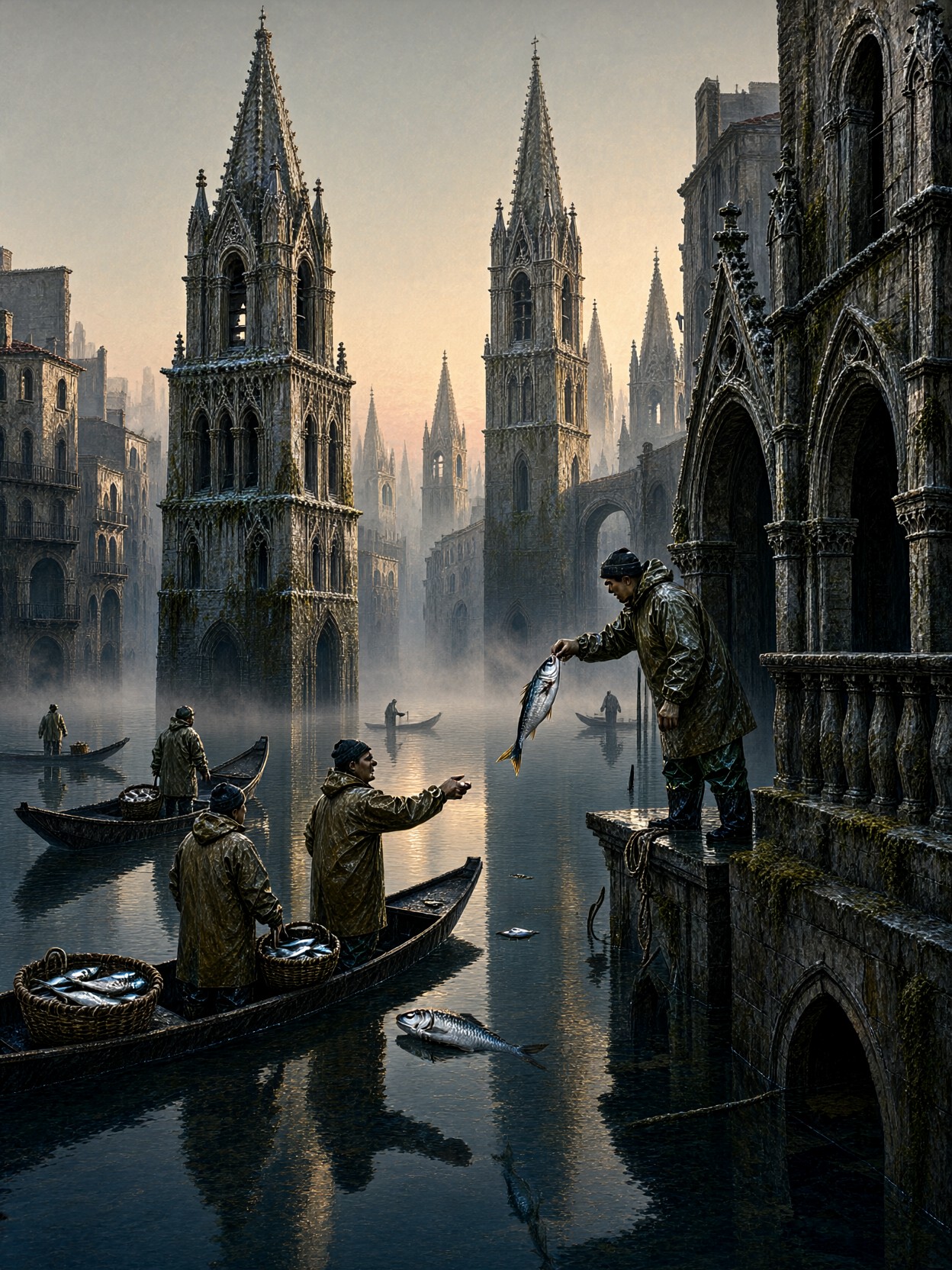
Half-submerged gothic bell towers rising out of glassy water at dawn — that single image carries the whole prompt. The drowned cathedral city works because it stacks contradictions: stillness against human bustle, decay against morning light, melancholy against commerce. Fishermen trade silver fish across flooded streets while mist drifts low, and the warm amber sunrise catches pointed spires above deep blues below.
The prompt is also a masterclass in layering. Surface detail (moss, salt streaks, oilskins) sits above the waterline, while sunken archways and drowned streets sit faintly below it — two visual planes that create the atmospheric depth the closing keywords demand. Volumetric haze and painterly brushwork tell Qwen 2.1 to behave like a concept artist, not a camera: soft edges, visible stroke texture, muted desaturated colour. It reads less like a photograph and more like establishing art for a film that doesn't exist.
World-Building Assets, Book Covers, and Environment Studies
Environment concept art like this earns its keep in pre-production. Game studios use wide establishing shots to lock a level's mood before a single 3D blockout exists; this prompt delivers exactly that — scale, palette, lighting direction, and human activity all in one frame. Fantasy and literary fiction covers are another strong fit, especially for novels with drowned-world or post-flood settings.
Stay wide and horizontal: 16:9 or 21:9 suits the establishing-shot framing, and cropping tighter kills the layered depth that makes the image work. The one limitation worth knowing — the fishermen are small figures in a large scene, so this prompt is not the tool for detailed character portraits. If you need faces, run a separate close-up prompt.
Dialing In Qwen 2.1 for Painterly Establishing Shots
Qwen 2.1's native 2K output is a genuine advantage here — the fine detail in carved stone facades, rope coils, and faint underwater archways survives without upscaling artefacts. Its lifelike lighting engine also handles the amber-on-blue colour contrast cleanly, which is where weaker models tend to muddy the water (literally).
- CFG / Guidance:
3.5— enough to honour the muted palette and haze keywords without over-saturating the amber light - Steps: 30 for maximum quality — the layered depth (above water, below water, mist) needs the full pass count; 12 works for composition previews
- Resolution:
1664×928for 16:9, or push to Qwen 2.1's native 2K width for print-quality establishing art
Keep "muted desaturated palette" in the prompt even though it fights the amber sunrise — that tension is what stops the model from rendering a postcard instead of concept art.
Five Ways to Reshape the Drowned City
5 Targeted Variations for This Prompt
- Flip the hour: Replace "warm amber sunrise light" with "cold blue dusk, lanterns flickering on balconies" — the mood shifts from hopeful melancholy to uneasy mystery, and the water becomes a dark mirror
- Change the weather, change the story: Swap "mist drifts low" for "storm surge, waves breaking against the bell towers" — same city, but now it's a survival scene; add "rain-streaked" to the oilskins for cohesion
- Go vertical: Change "wide establishing shot" to "low-angle view from a gondola, towering spires loom overhead" — a 3:4 crop that trades environmental context for scale and awe
- Reframe the culture: Replace "gothic bell towers" with "Moorish domes and tiled minarets" and "gondolas" with "reed boats" — the drowned city moves from Venice-adjacent Europe to a desert civilization flooded by a shifting sea
- Desert the water entirely: Swap "glassy water" for "cracked salt flats, the city buried in sand dunes" — a post-drought version where the fishermen become scavengers; keep everything else and the melancholy survives the rewrite
Two Prompts Ready to Generate
Both examples below apply variations from the list above and are tuned for Qwen 2.1 at cfg 3.5, 30 steps, wide format.
Variation: dusk flip — amber dawn becomes cold blue evening with lantern light, trading the hopeful mood for quiet unease
Concept Art, painted digital illustration. A drowned cathedral city at dusk: half-submerged gothic bell towers rise from dark glassy water, carved stone facades streaked with moss and salt. Fishermen in weathered oilskins trade baskets of silver fish from narrow flat-bottomed gondolas, lanterns flickering on flooded stone balconies. Low mist, cold blue light, lantern glow reflecting on the surface, sunken archways faintly visible beneath, deep blues and muted golds, volumetric haze, painterly brushwork, quiet melancholic mood, highly detailed, 8k.
Variation: Moorish reframe — gothic spires become tiled domes and minarets, gondolas become reed boats, the drowned world shifts to a flooded desert civilization
Concept Art, painted digital illustration. A drowned desert city at dawn: half-submerged Moorish domes and tiled minarets rise from still, glassy water, their facades streaked with salt and fading turquoise tiles. Traders in weathered robes stand in narrow reed boats, passing baskets of silver fish and coiled rope across the water. Mist drifts low, warm amber sunrise light catching the domes, deep blues and muted golds below. Sunken archways faintly visible beneath the surface. Wide establishing shot, atmospheric depth, volumetric haze, painterly brushwork, muted desaturated palette, quiet melancholic mood, highly detailed, 8k.
More Atmospheric World-Building Prompts
These prompts explore the same territory from other angles — a lost ships harbour, a warm interior glowing against the dark, a library steeped in Renaissance light, and a forge burning at dusk: