Zero-Gravity Cathedrals: How This Orbital Station Render Works
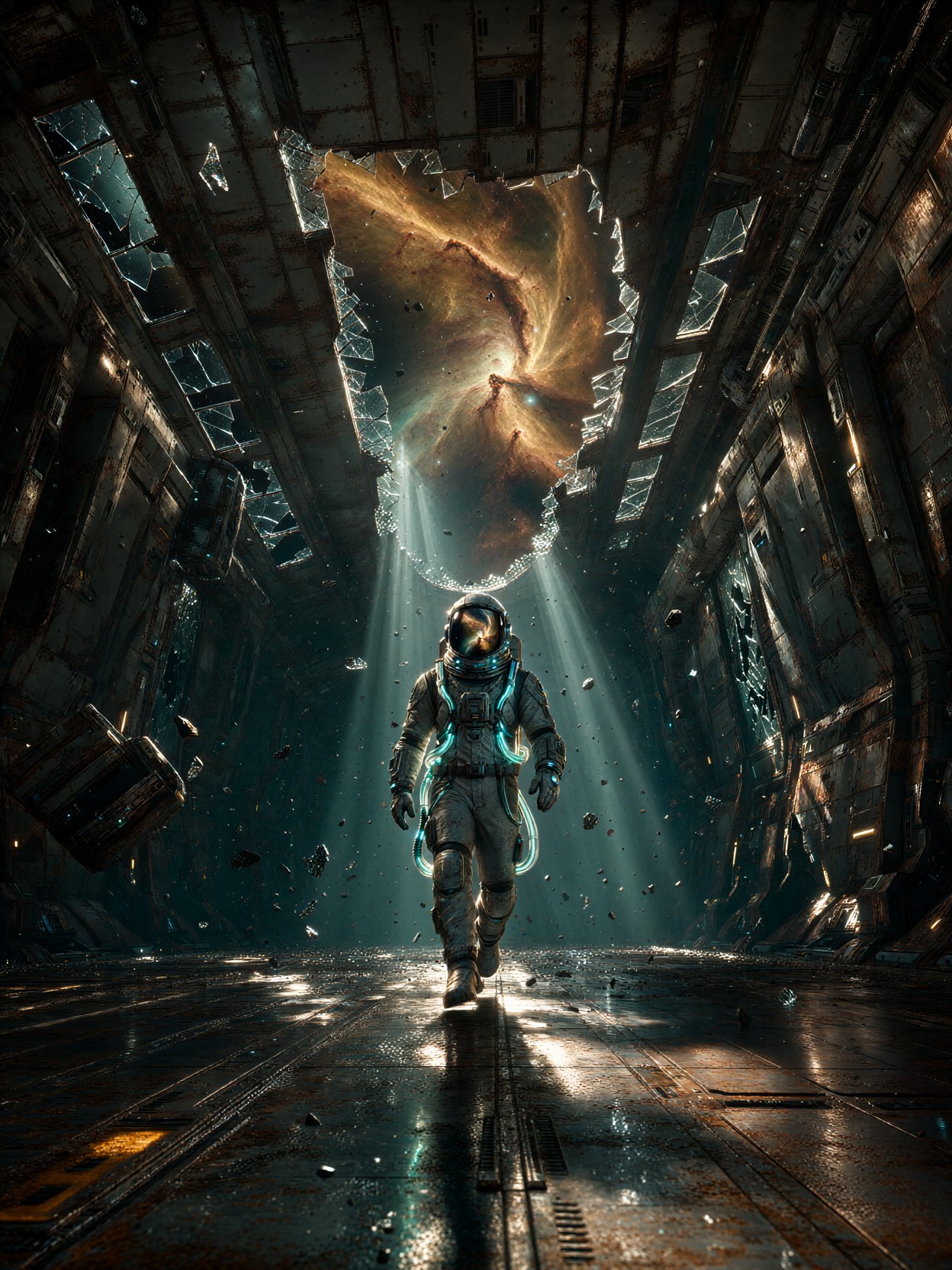
The most striking trick here is the hull breach as a window — instead of sealing the station, the damage becomes the light source, pouring volumetric shafts of amber nebula into a dead corridor. That single decision turns a derelict space station into something closer to a cathedral: vertical scale, dust drifting like incense, shattered glass catching the glow.
The teal and burnt orange palette does the rest. Cyan conduits on the exosuit echo the teal shadows, while the nebula feeds the warm side of the frame, and the visor reflection ties subject and environment into one story. Qwen 2.1 handles this composition well — its native 2K output resolves fine corrosion texture on the titanium panels, and its lifelike lighting instincts sell the ray-traced wet-floor reflections without extra prompting.
Game Key Art, Book Covers, and Concept Boards
Sci-fi concept artists, indie game studios needing key art, and self-publishing authors looking for a cover for a space-opera novel are the obvious beneficiaries. The lone-figure-in-vast-interior composition also works beautifully as a desktop wallpaper or D&D-style campaign splash for a sci-fi campaign.
Go cinematic 16:9 — 1664×928 or higher. The corridor's vertical scale still reads in landscape, and the wide frame gives the light shafts room to rake across the composition. A 3:4 portrait crop will crush the nebula reveal.
Settings for Qwen 2.1 — Preserving the Volumetric Light
Qwen 2.1's native 2K generation means you can render at full detail without upscaling artefacts, but the volumetric shafts need moderate guidance — push true_cfg_scale too high and the haze hardens into visible beams with no atmosphere.
- Guidance:
3.0–3.5— keeps volumetric haze soft while holding the crisp panel edges - Steps: 30 for final quality; 12 for composition previews
- Resolution:
1664×928(16:9) for cinematic framing,2048×1152for wallpaper-grade output
Because Qwen 2.1 renders fine detail natively, resist the urge to stack quality keywords — "8k, highly detailed" is enough. Extra emphasis tends to sharpen the dust particles into distracting specks.
Five Ways to Push the Derelict Station Further
5 Targeted Variations for This Prompt
- Flip the light source: Replace "swirling amber nebula" with "a collapsing star, blinding white core" — the palette shifts from warm nostalgia to apocalyptic awe, and the cyan conduits pop harder against the blown-out light
- Change the era of decay: Swap "corroded titanium panels" for "overgrown with pale alien vines" — the derelict becomes a reclaimed ruin, blending sci-fi with organic horror
- Scale contrast: Change "lone explorer" to "a swarm of small maintenance drones, each with blinking amber lights" — removes the human anchor and makes the corridor feel even more vast and abandoned
- Vertical cathedral: Add "extreme low angle looking up, multiple stacked walkways" — emphasises the cathedral metaphor and suits a tall 3:4 wallpaper crop
- Narrative twist: Replace "walks mid-frame" with "kneels beside an old cryo-pod, its frost-covered glass cracked open" — the image gains a story beat and a second focal point
Two Prompts Ready to Generate
Both examples below apply variations from the list above, tuned for Qwen 2.1 at the settings recommended earlier.
Variation: collapsing-star light source — the amber nebula becomes a blinding stellar death, shifting the mood from melancholy to apocalypse
Unreal Engine Style, cinematic 3D render. A colossal derelict orbital station interior, vast cathedral-like corridor of corroded titanium panels and shattered glass, volumetric light shafts piercing through a hull breach to reveal a collapsing star, blinding white core. A lone explorer in a weathered white exosuit with glowing cyan conduits walks mid-frame, visor reflecting the dying star. Floating dust in zero gravity, deep teal and searing white palette, ray-traced wet floor reflections, hyperrealistic materials, 8k, highly detailed
Variation: narrative twist with cryo-pod — adds a story focal point and a second light source, turning the corridor into a scene rather than a vista
Unreal Engine Style, cinematic 3D render. A derelict orbital station corridor of corroded titanium panels and shattered glass, volumetric amber nebula light shafts through a hull breach. A lone explorer in a weathered white exosuit with glowing cyan conduits kneels beside an old cryo-pod, its frost-covered glass cracked open, faint blue glow spilling out. Floating dust in zero gravity, deep teal and burnt orange palette, ray-traced reflections on wet metal flooring, hyperrealistic materials, 8k, highly detailed
More Cinematic Character and Scene Prompts
These prompts explore cinematic lighting and atmospheric staging from other angles — ornate portrait drama, neon cityscapes, and dreamlike environments: