

Amber Glow Against the Abyss: How This Underwater Scene Comes Alive
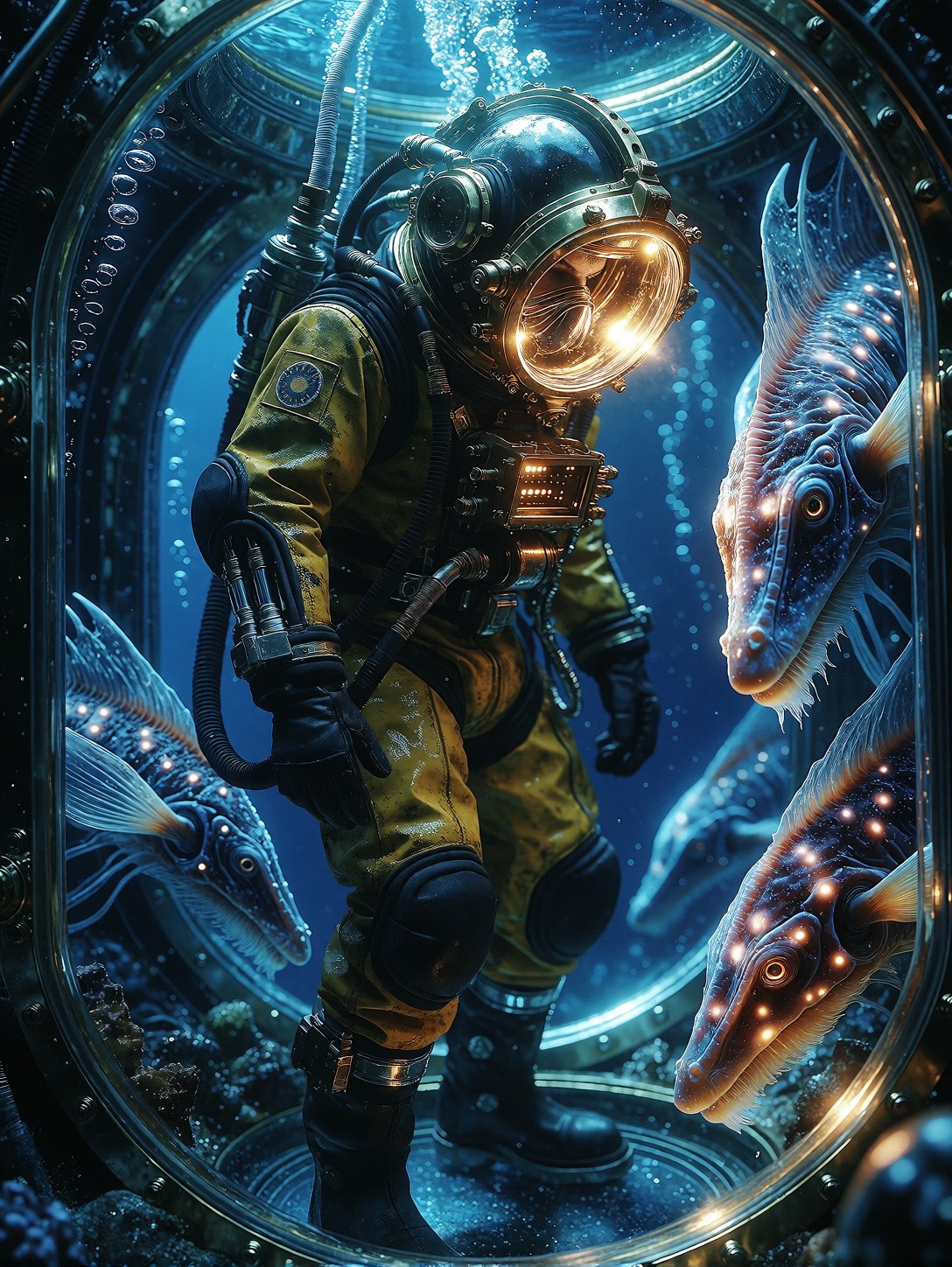
The deep yellow polymer of a heavy diving suit clashes beautifully with the crushing blue of the abyss, and Proxima Aurelia 2 knows exactly how to make that contrast breathe. Placing an engineer inside a glass control dome on the sea floor turns architectural visualization into pure sci-fi storytelling. The model latches onto the brass-rimmed helmet’s warm amber glow, letting it act as the primary light source that bounces across wet metal and curved transparency. Colossal bioluminescent silhouettes drift past the glass, giving the scene scale without cluttering the focal point. Every hydraulic piston and polymer seam gets rendered with crisp technical clarity, while the high-contrast ambient lighting wraps the dome in rich reflections that feel almost tangible.
Concept Art, Game Assets, and Sci-Fi Publishing
Concept artists building underwater exploration environments, indie developers designing deep-sea survival games, and publishers needing cover art for oceanic thrillers will find this setup highly efficient. The vertical composition naturally highlights the engineer’s silhouette against the towering glass structure, making it ideal for 3:4 portrait framing. If you’re pushing this into a cinematic wide layout, keep the camera low to emphasize the dome’s curvature and the looming size of the passing leviathans.
Settings for Proxima Aurelia 2 — Guiding Intelligent Composition
Proxima Aurelia 2 delivers exceptional aesthetics and rich visual storytelling by default, but glass reflections and underwater light diffusion still need stable grounding to prevent the subject from washing out.
- CFG / Guidance:
3.5— maintains crisp polymer textures and brass highlights without blowing out the amber interior glow - Steps: 28–30 for full bioluminescent detail and reflective accuracy; drop to 16 if you’re iterating on framing
- Resolution:
1080×1440(3:4) for vertical scale;1664×928(16:9) if you need a cinematic wide layout
Abovecfg 4.0, Aurelia 2 tends to over-sharpen the water refraction, turning glass into opaque plastic. Stick to3.5and let the model handle the optical physics naturally.
Combining the LoRAs
- Cinematic Shot Look at
0.60— sets the camera language, framing, and dramatic lighting balance; this should be your anchor style - Midjourney-Style Rendering at
0.50— polishes surfaces and smooths tonal gradients; keep it equal to or slightly below the Cinematic LoRA to avoid conflicting camera angles - Gothic Mystic / Dark Sensual Gothic at
30–40only — these styles inject heavy mood and biomechanical texture, but pushing them past60will overwrite the technical sci-fi aesthetic; use them strictly for atmospheric depth
For balanced composition, keep combined weights between 30 and 60 per style layer. Push any single style above 70 only if you want it to dominate the lighting or texture entirely.
Five Targeted Variations for the Underwater Engineer
5 Concrete Directions to Experiment With
- Shift the depth: Replace "sea floor" with "sun-drenched shallows, surface storm clouds above" — light shafts pierce the water, turning the amber helmet glow into a secondary accent rather than the primary source
- Change the suit material: Swap "dark yellow reinforced polymer" for "weathered white ceramic plating, scuffed titanium joints" — the aesthetic shifts from industrial utility to expeditionary survival gear
- Add a mechanical companion: Insert "a floating maintenance drone with articulated arms, hovering near the dome’s control console" — introduces scale, narrative tension, and dynamic foreground interest
- Condense the environment: Replace "colossal bioluminescent sea creatures passing by" with "dense kelp forest, glowing plankton trails, narrow visibility" — creates claustrophobic depth perfect for horror-tinged sci-fi
- Reframe the architecture: Change "glass control dome" to "hexagonal crystalline observation blister, refracting water distortion" — leans into hard-sci-fi optical physics and sharp geometric composition
Two Prompts Ready to Generate
Apply two of the variations above directly — both are tuned for Proxima Aurelia 2 at the settings recommended above.
Variation: sun-drenched shallows + maintenance drone — shifts lighting to surface shafts and adds a mechanical companion for narrative scale
Cinematic full-body shot of a male underwater engineer standing inside a vast glass control dome in sun-drenched shallows, storm clouds visible above. He wears a heavy deep-sea suit made of weathered white ceramic plating and scuffed titanium joints, exposed hydraulic pistons, thick brass-rimmed helmet glowing with warm amber interior light. A floating maintenance drone hovers near the console. Deep blue ocean water filled with glowing plankton trails, high-contrast ambient lighting, rich metal reflections, crisp technical details, photorealistic, 8k resolution.
Variation: hexagonal crystalline blister — replaces the dome with refractive crystal geometry and presses bioluminescent silhouettes against the walls for tighter composition
Cinematic full-body shot of a male underwater engineer standing inside a hexagonal crystalline observation blister on the sea floor. He wears a heavy deep-sea suit made of dark yellow reinforced polymer, exposed hydraulic pistons, thick brass-rimmed helmet glowing with warm amber interior light. Deep blue ocean water surrounds the crystal walls, filled with colossal bioluminescent silhouettes pressing against the glass. High-contrast ambient lighting, refracted water distortion, rich reflections, crisp technical details, photorealistic, 8k resolution.
More Cinematic Sci-Fi and Character Studies
Other prompts in this category push similar cinematic framing and atmospheric lighting from different angles — orbital mechanics, neon-drenched alleys, and cosmic scale: