The Symphony of Sizzle and Neon: Crafting a Gritty Cyberpunk Street Scene
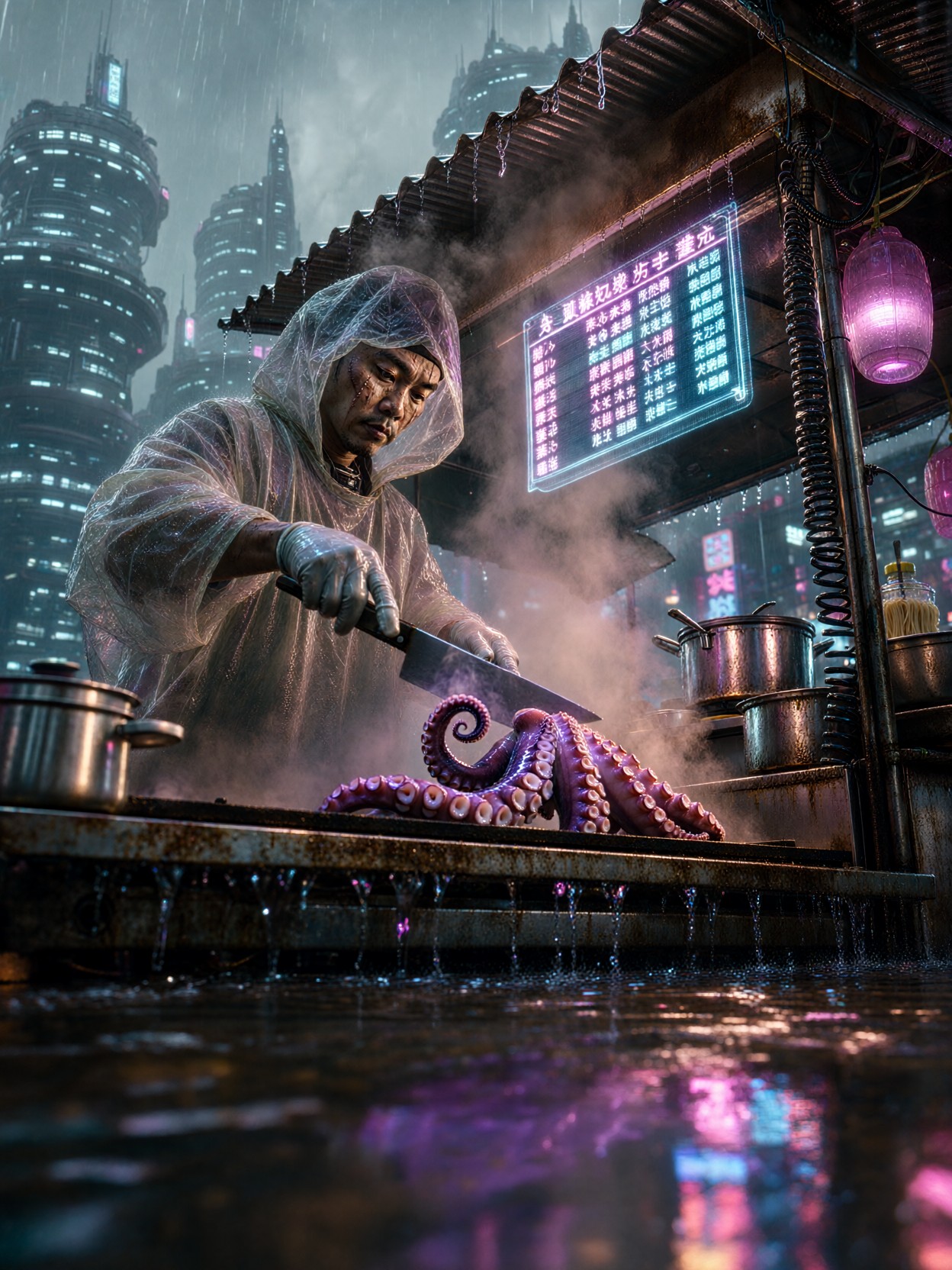
A weathered street chef, surrounded by a jumble of chrome pots and glowing polymer lanterns, becomes the perfect anchor for a dystopian landscape where rain and neon clash. The visual focus is the moment before the slice—glistening synthetic octopus tentacles curl in heat haze over a sizzling teppan grill, all while a flickering holographic menu casts impossible light across the downpour.
The magic of this prompt lies in the contrast between the human element and the overwhelming high-tech environment. The chef's scarred, focused expression grounds the chaos of the rain-slicked street, while the looming arcologies in the background provide the necessary scale to make the scene feel truly massive. Qwen 2.1 is particularly adept at handling this level of complex detail and the sharp definition of the neon signs and holographic displays. It thrives on the interplay of moisture, artificial light, and intricate mechanical clutter.
Who Needs This Level of Detail in Their AI Art?
If you are developing a concept for a futuristic neo-noir film, designing assets for a cyberpunk video game (especially for atmospheric environmental pieces), or creating highly detailed illustration for a sci-fi comic book, this prompt is your foundation. This style of image excels at conveying "mood" over pure action.
For optimal results, lean into a wide aspect ratio like 16:9 or 21:9 to allow the towering arcologies and the sprawling noodle stall environment to be fully appreciated without feeling claustrophobic.
Optimizing Settings for Qwen 2.1 — Harnessing Detail and Light
Since Qwen 2.1 is designed for high fidelity and strong lighting, we want to leverage its strengths in texture and crisp visual information. The key to making this prompt work is ensuring the model dedicates enough processing power to the secondary elements—the holographic text and the fractured reflections.
- Guidance Scale (CFG):
7.0–9.0. Because the prompt is highly descriptive and relies on specific visual rules (like the light casting on the octopus), a higher guidance scale will force the model to adhere strictly to the "violet-slicked heat haze" and "magenta glowing lanterns." - Steps: 30+ for maximum quality. Given the complexity of the rain, chrome, and biological textures, a lower step count will likely result in smudged surfaces.
- Resolution: Native 2K output is a bonus, but for cinematic use, aim for
1920×1080or higher if the platform allows for upscaling, focusing on the horizontal cinematic feel.
Qwen 2.1's native typography strength means that the flickering holographic menu should render with surprising legibility and sharp edges—this is a perfect model to test its capabilities against the complexity of a detailed sci-fi sign.
Creative Directions to Experiment With This Scene
Five Targeted Variations for the Cyberpunk Chef
- Shift the Color Palette: Replace "flickering holographic menu" and "magenta glowing lanterns" with "low-power, sickly amber CRT menu" and "dim, caged sodium vapor lamps." This immediately shifts the mood from vibrant cyberpunk to a grittier, more depressed, retro-futuristic feel.
- Change the Subject's Interaction: Instead of "slicing glistening synthetic octopus," change the action to "carefully calibrating a series of complex, glowing cybernetic prosthetic hands" while the rain falls. This shifts the focus from food preparation to engineering or maintenance.
- Modify the Environment's Height: Instead of "tower arcologies loom," change it to "a dense, low-lying subterranean market, choked with steam and tangled fiber-optic cables." This instantly changes the scale from vast city to claustrophobic urban sprawl.
- Adjust the Weather Intensity: Replace "rain mingle" with "thick, sulfurous chemical fog rolling off the polluted waterway." This swaps the wet, reflective mood for a toxic, muffled atmosphere, altering how the neon signs refract light.
- Style Swap: Add the phrase "rendered in the style of a 1980s anime cel-shaded illustration" to the end of the prompt. This will take the hyper-detailed photorealism and flatten it into a distinct, stylized animation aesthetic, while keeping all the elements of the scene intact.
Two Prompts Ready to Generate
We are going to explore the shift from vibrant neon life to a more desolate, toxic atmosphere using the variations above.
Variation: Desolate, toxic atmosphere — shifting the vibrant neon palette to a murky, sickly green and orange to suggest environmental collapse or pollution.
A weathered street chef in a translucent monsoon poncho tends a sizzling teppan grill under a low-power, sickly amber CRT menu. He is slicing glistening synthetic octopus tentacles that curl in toxic green heat haze. Steam and toxic fog mingle above his rusted noodle stall, a jumble of chrome pots, coiled cables, and hanging dim, caged sodium vapor lamps. Behind him, massive, corroded structures loom through sheets of chemical mist. Cinematic 35mm, low angle, moody, humid, 8k.
Variation: Subterranean market setting — transforming the grand city arcologies into a claustrophobic, low-level sprawl hidden beneath the street level.
A weathered street chef in a translucent monsoon poncho tends a sizzling teppan grill under a flickering holographic menu, slicing glistening synthetic octopus tentacles that curl in violet-slicked heat haze. Steam and rain mingle above his rusted noodle stall, surrounded by a dense, low-level subterranean market, a jumble of chrome pots, coiled cables, and hanging polymer lanterns glowing magenta. The ceiling is a tangle of conduits and neon signage. Cinematic 35mm, low angle, moody, humid, highly detailed, 8k.
More Futuristic Urban Concepts
If this fusion of high-tech detail and grit appeals to you, exploring other themes in the futuristic and street-level domains can provide endless inspiration for your AI art journey.