

Micro-Soldering Above a Neon Ocean: What Makes This Cyberpunk Scene Work
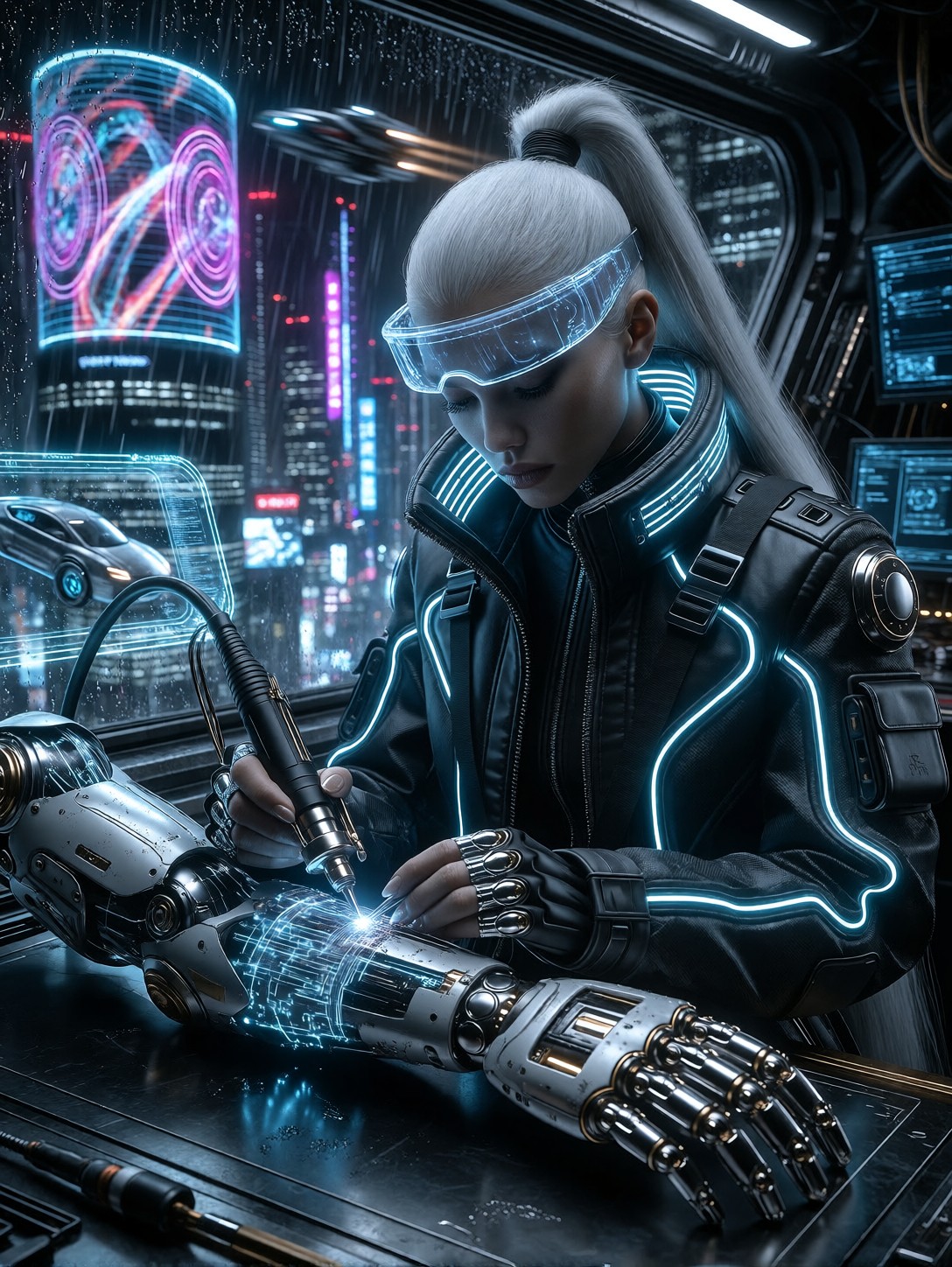
The most striking choice here isn't the metropolis — it's the scale contrast. A tiny laser tip touching glowing circuitry in the foreground, while an entire rain-streaked city of holograms burns behind one panoramic window. Proxima Aurelia 2 thrives on exactly this kind of visual storytelling: the model reads "focused, serene expression" and "eyes fixed entirely on her delicate task" and translates it into genuine narrative tension, not just a pretty face.
The lighting does the rest. Cyan fiber-optic piping on the jacket, magenta bleed from distant advertising screens, and the sharp glint of the soldering tool give the model three distinct light sources to sculpt with — the result is editorial-grade contrast with cinematic depth of field separating the subject from the skyline.
Editorial Spreads, Game Key Art, and Tech Branding
The medium-full framing and high-fashion techwear styling make this output a natural fit for magazine-style editorial layouts, cyberpunk tabletop RPG character art, and concept sheets for game protagonists. Tech brands and synthwave music covers can also borrow the cyan-on-matte-black palette directly.
Stick to a 3:4 portrait or 1080×1440 frame — the vertical crop preserves both the workshop interior and the skyline behind her. A 16:9 landscape works only if you push the camera wider and accept less intimacy with the soldering detail.
Settings for Proxima Aurelia 2 — Letting the Storyteller Breathe
Aurelia 2 is built for intelligent composition and rich narrative from minimal prompting, so resist the urge to over-crank guidance — the model composes best with room to interpret.
- CFG / Guidance:
3.0–3.5— high enough to hold the cyan/magenta color discipline, low enough to keep skin and fabric natural - Steps: 12 for composition previews, 30 for maximum detail on circuitry, rain streaks, and fabric weave
- Resolution:
1080×1440(3:4 portrait);1664×928if you reframe as cinematic 16:9
Because Aurelia 2 excels at visual storytelling, keep the "focused and serene expression" phrase even when varying other elements — it anchors the entire mood and prevents the model from drifting into generic action poses.
Layering the LoRAs
Three style LoRAs at moderate weights can either harmonize beautifully or fight each other — here's how to keep them on the same team:
- Stellaris at
0.50— the backbone here; it supplies the orbital-tech atmosphere, robotic prosthetics, and futuristic vehicle logic. Keep it at 0.45–0.55 - 1950s Sci-Fi Movie Look at
0.35–0.40— at full 0.50 its retro technicolor grading will clash with the neon cyan/magenta palette. Lower it if you want crisp modern color; raise to 0.60+ only if you deliberately want a vintage-futurism mashup - Velvet Crypt at
0.25–0.30— a whisper of smudged glamour and decadent texture enriches the fabric realism, but above 0.40 it drags the scene toward tattered Victorian gothic and muddies the clean techwear lines
For a pure cyberpunk editorial look, run Stellaris alone or with Velvet Crypt at 0.25 and drop the 1950s LoRA entirely.
Five Ways to Push the Cyber-Technician Further
5 Targeted Variations for This Neo-Tokyo Workshop Scene
- Swap the task: Change "micro-soldering circuits onto a prosthetic arm" to "engraving glowing kanji onto a chrome android skull" — same composition, but the focal glow shifts from circuit-board green-cyan to engraved script, adding cultural specificity
- Flip the time of day: Replace "cyberpunk rain" and neon night with "dawn breaking over the metropolis, soft pink light mixing with fading holograms" — the city winds down, and the mood turns contemplative instead of electric
- Lean vintage: Raise the 1950s Sci-Fi LoRA to
0.65and add "retro-futurism, analog dials, cathode-ray monitor" — the workshop becomes a loving pastiche of mid-century sci-fi set design - Go wider: Add "wide establishing shot, full workshop visible, 16:9" — trades intimacy for scale, ideal for game key art or desktop wallpapers
- Add a companion: Insert "a small hovering maintenance drone with a single lens eye watches her work" — a second character gives Aurelia 2's storytelling engine a relationship to render, and the drone's eye becomes a natural light source
Two Prompts Ready to Generate
Both examples below apply variations from the list above, tuned for Aurelia 2 at the recommended settings.
Variation: swapped task and added drone companion — the soldering becomes engraved kanji, and a watching drone adds narrative depth and a second light source
Cyberpunk Neo-Tokyo, cinematic medium-full shot. A young female cyber-technician with a focused, serene expression engraves glowing kanji onto a chrome android skull inside a high-tech workshop above a neon metropolis. Matte-black techwear jacket with cyan fiber-optic piping, stark-white geometric ponytail, holographic visor on forehead. A small hovering maintenance drone with a single lens eye watches her work. Panoramic window behind: holographic ads, flying vehicles, cyberpunk rain. High-contrast cyan and magenta neon lighting, crisp refractions, cinematic depth of field, 8K, 3:4 portrait
Variation: dawn mood shift — neon night gives way to soft morning light, trading electric energy for quiet contemplation
Cinematic medium-full shot, dawn over Neo-Tokyo. A skilled young female cyber-technician, calm and absorbed, micro-solders glowing circuits onto a robotic prosthetic arm with a precision laser tool. Matte-black carbon techwear jacket with cyan fiber-optic piping, stark-white high ponytail, translucent visor on her forehead. Soft pink dawn light through the panoramic window mixes with fading holographic advertisements as the city sleeps, last flying vehicles streaking home. Gentle contrast, warm-cool color interplay, extreme fabric and metal realism, cinematic depth of field, 8K, 3:4 portrait
More Cyberpunk Scenes in This Direction
These prompts explore adjacent corners of the neon-future aesthetic — performance, combat, fashion, and glamour: