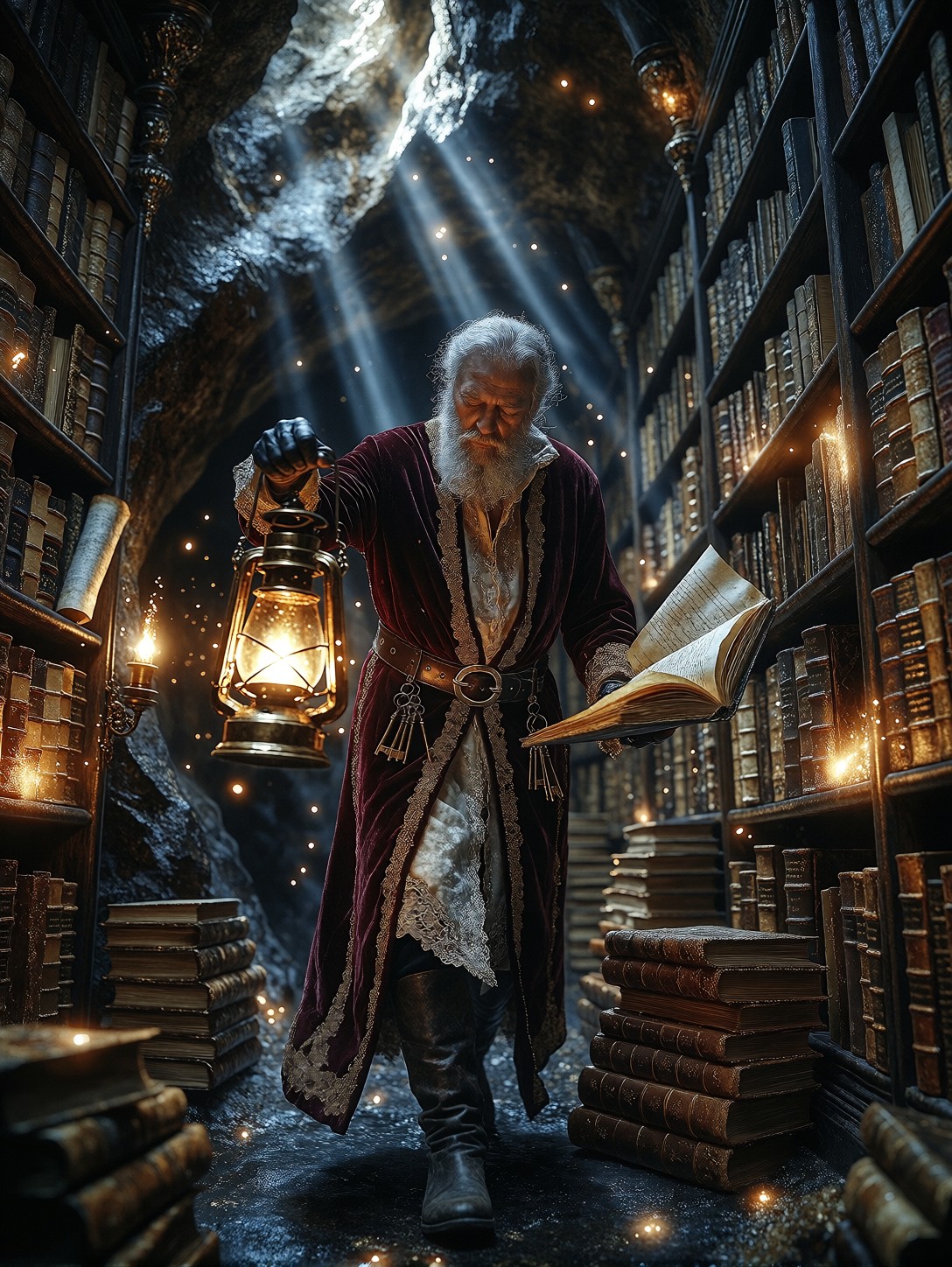


The Swinging Lantern and Deep Rock: How This Subterranean Scene Works
The swinging brass lantern is the visual anchor here — its warm amber glow doesn’t just illuminate the scene, it actively sculpts the deep shadows of a colossal library carved straight into solid rock. Proxima Aurelia 2 uses that single light source to drive intelligent composition: dust motes catch the beams like suspended gold, while the rich burgundy velvet of the archivist’s robe and the weathered leather spines absorb the warmth without losing texture. The wide cinematic framing pushes the endless spiraling bookshelves into the background, creating a sense of infinite scale that feels both ancient and deeply atmospheric. Every surface from the hanging keys to the glowing scrolls is rendered with enough tactile weight to make you want to reach out and touch it.
Concept Art, TTRPG Campaigns, and Editorial Spreads
This composition is built for world-building and environmental storytelling. Concept artists crafting campaign settings, authors looking for cover inspiration, and game developers designing dungeon environments will find this layout highly adaptable. The cinematic wide framing demands a horizontal orientation — aim for 16:9 or 21:9 to let the spiraling architecture stretch naturally without forcing awkward crops. Avoid vertical formats here; they will compress the library’s scale and break the intended sense of vastness.
Settings for Proxima Aurelia 2 — Guiding Composition Without Overriding It
Aurelia 2 is engineered to extract rich visual storytelling from straightforward prompts, so the generation parameters should support its natural rendering workflow rather than fight it. Keep guidance moderate to preserve its lighting transitions and let the model handle the heavy lifting on texture detail.
- true_cfg_scale:
3.0–3.5— enough control to keep the archivist’s silhouette sharp without flattening the lantern’s volumetric glow - Steps: 24–30 for full atmospheric depth; drop to 16 if iterating on layout
- Resolution:
1664×928(16:9) — matches the cinematic wide shot framing perfectly
Aurelia 2 thrives on aesthetic intuition. Let it guide the composition by avoiding over-specification in the lighting tags and trusting its natural balance.
Combining the LoRAs
You’re working with three distinct style drivers here, so balance is critical. The recommended weight range for combining multiple aesthetic LoRA styles sits between 0.30–0.60 for subtle influence, while pushing past 0.70+ will cause stylistic clashes or texture bleeding.
- Gothic Mystic Portrait Style at
0.55— anchors the archivist’s face and robes with ornate, dreamlike detail without distorting anatomy - Dark Sensual Gothic Fantasy Style at
0.45— deepens the rock textures and adds subtle aged-metal grit to the lantern and keys - Midjourney-Style Rendering at
0.50— polishes the final output, boosting contrast and giving that signature cinematic sharpness to the bookshelf edges and dust particles
If you prefer a cleaner, more traditional photographic look, drop Gothic Mystic Portrait Style to 0.35 and let Midjourney-Style Rendering take the lead at 0.65.
Five Ways to Push the Subterranean Library Further
5 Targeted Variations for This Prompt
- Shift the era: Replace "ancient leather books" with "crystalline data spires and holographic archives" — transforms the setting into a sci-fi vault while keeping the exact lighting and composition
- Change the weather/environment: Add "steam rising from geothermal vents, wet stone floors reflecting the lantern glow" — introduces atmospheric humidity that makes the amber light scatter more dynamically
- Rearrange the subject: Change "walking through" to "perched on a crumbling stone lectern, reading a massive tome" — shifts focus from exploration to scholarly isolation, perfect for character studies
- Alter the color temperature: Swap "warm amber light" for "cold blue bioluminescent fungi lining the fissures" — flips the mood from cozy antiquity to eerie ancient mystery
- Add architectural scale: Insert "massive iron chain bridges spanning a bottomless chasm, distant torches flickering on opposite cliffs" — expands the environment into a full diorama layout ideal for editorial spreads
Two Prompts Ready to Generate
These two outputs apply the environmental and architectural variations above, tuned specifically for Proxima Aurelia 2’s compositional strengths.
Variation: cold blue bioluminescent lighting — flips the cozy antiquity into an eerie ancient mystery, with fungal glow scattering through the rock fissures
Fantasy, Interior Design. Cinematic wide shot of an old male archivist walking through a colossal subterranean library cut into dark rock. He wears a rich burgundy velvet robe with gold lace trim and a dark leather belt with hanging keys. He holds a swinging brass lantern casting cold blue bioluminescent glow on endless spiraling bookshelves filled with ancient leather books and glowing scrolls. Floating dust motes catch dramatic light beams cutting down from high rock fissures lined with luminous moss. Deep contrast, rich wood and paper textures, high detail, photorealistic, 8k resolution.
Variation: expanded architectural scale — adds chain bridges and distant torches to create a full diorama layout ideal for editorial spreads while keeping the archivist as the focal point
Fantasy, Interior Design. Cinematic wide shot of an old male archivist walking through a colossal subterranean library cut into dark rock. He wears a rich burgundy velvet robe with gold lace trim and a dark leather belt with hanging keys. He holds a swinging brass lantern casting warm amber light on endless spiraling bookshelves filled with ancient leather books and glowing scrolls. Massive iron chain bridges span a bottomless chasm, distant torches flicker on opposite cliffs. Floating dust motes catch dramatic light beams. Deep contrast, rich wood and paper textures, high detail, photorealistic, 8k resolution.
More Cinematic Environments in This Direction
If you enjoy the atmospheric scale and dramatic lighting of this subterranean scene, these related compositions explore similar world-building territories: