

Lapis Pillars, Torchlight, and a Gaze That Holds the Frame
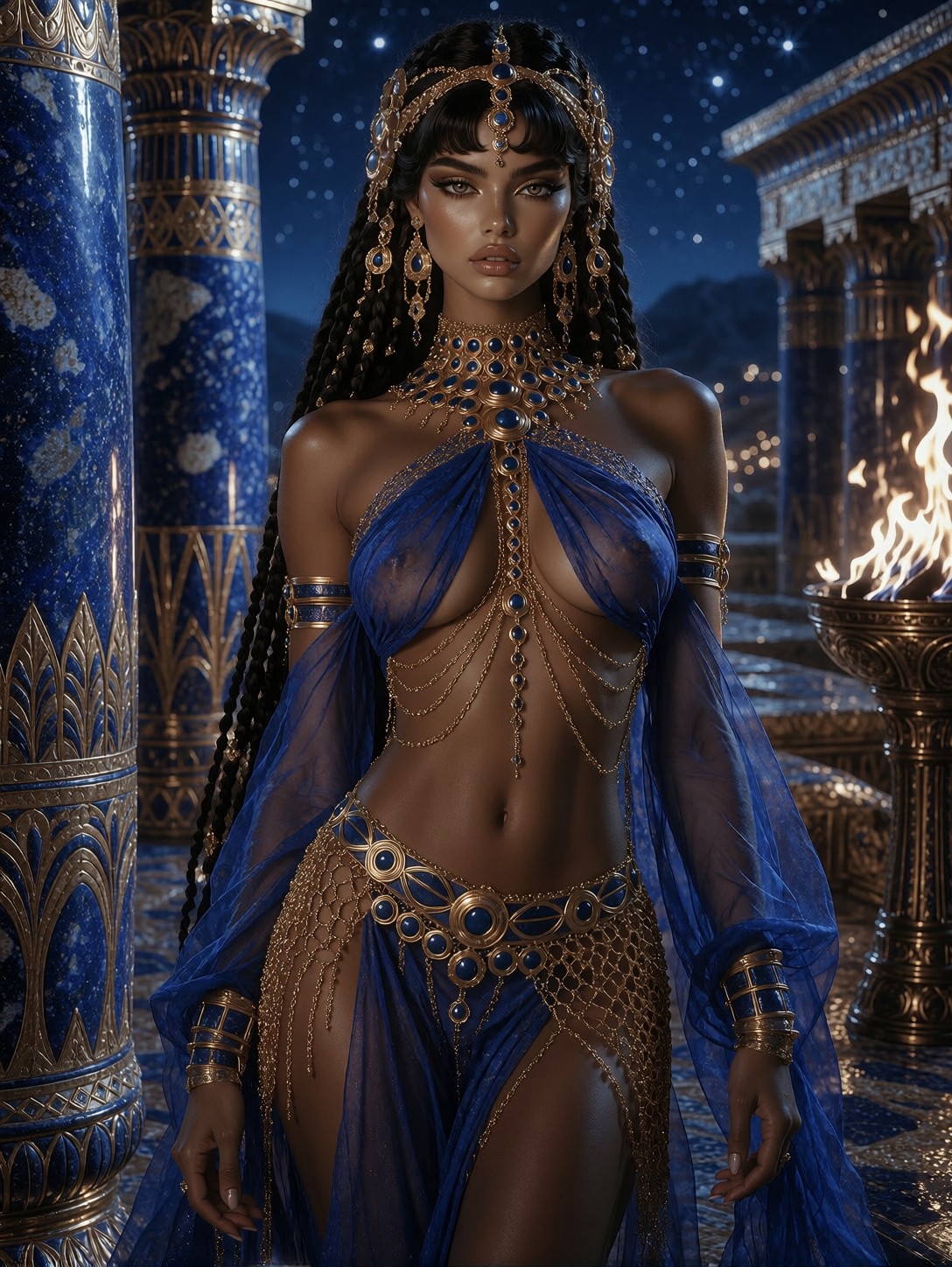
Two carved lapis-lazuli pillars do something unexpected here: they stop being architecture and start being a frame, bracketing the goddess so the eye has nowhere to go but her face. Proxima Aurelia 2 thrives on exactly this kind of staging — the deep ultramarine of the stone against warm, flickering bronze torchlight creates a complementary push-pull that reads as instantly cinematic.
The material storytelling is where the model earns its keep. Semi-sheer royal-blue chiffon, gold chain mail contouring the silhouette, body chains catching firelight across collarbones and skin — each texture demands a different render behavior, and Aurelia 2's intelligent composition resolves all three without them muddying each other. Add the 85mm f/1.4 lens language and extreme focus on skin pores, and the result sits comfortably between museum photography and film still.
Fantasy Book Covers, Goddess Art, and Editorial Mood Boards
Mythological glamour of this caliber is a natural fit for fantasy novel covers, goddess-themed wall art, tabletop deity cards, and luxury editorial mood boards. The waist-up portrait framing means the image also works beautifully as a character portrait for RPG campaigns or a striking social media centerpiece.
Stay portrait-oriented — 3:4 or 2:3 — so both pillars remain visible and the vertical torchlight falloff has room to breathe. Wide crops will amputate the pillars and destroy the framing device that makes the composition work. Note the sensual styling: for commercial contexts, soften wording like "seductive gaze" to "intense gaze" to keep outputs platform-friendly.
Settings for Proxima Aurelia 2 — Letting the Torchlight Breathe
Aurelia 2 is built to deliver rich visual storytelling from minimal prompting, so resist the urge to over-crank guidance — the model's aesthetic instincts are stronger than your negative prompts.
- CFG / Guidance:
3.0–3.5— high enough to hold the metallic luster, low enough that torchlight stays soft rather than clipped - Steps: 30 for final quality — the sheer chiffon and chain mail interplay needs full refinement; 12 steps only for composition previews
- Resolution:
1080×1440(3:4) portrait native;1344×1792if you plan to print
The torches are your light source — keep "warm, flickering" in the prompt. Swap it for "cool moonlight" and the gold ornaments lose their glisten, flattening the entire image.
Working with the LoRA Stack
This is a four-way stack, and the weights decide who wins the frame:
- GPT style at
70— dominant. Its gilded, celestial-cinematic glow reinforces the mythic scale and metallic detail; this is the backbone of the look - Dark Glamour 80s at
50— adds glossy makeup sheen and dreamy glow; above60it starts pulling pastel tones that fight the deep blues - Realistic Smartphone Snapshot at
70— the wildcard. At this weight it will push toward candid framing and flatten the cinematic lighting; drop to30–40if you want to keep the staged grandeur - PhotoReal Better Nudes at
65— pushes photoreal skin and figure realism without altering facial identity; useful here since the outfit is semi-sheer
For maximum cinematic drama, cut the Smartphone Snapshot to 30 and let GPT style and PhotoReal carry the image. For a gritty, "found footage of a real ritual" energy, raise Snapshot to 80 and accept a softer, less polished frame.
Five Ways to Reshape the Babylonian Goddess
Five Targeted Variations for This Torchlit Palace Portrait
- Swap the material palette: Change "lapis-lazuli pillars" to "carved obsidian pillars" — the scene turns volcanic and severe, gold reads hotter against black, and the mood shifts from regal to dangerous
- Move the time of day: Replace "starry night" with "blood-red dawn over the Euphrates" — cool torchlight becomes contested by warm horizon light, creating a two-source color story
- Shift the deity: Change "Babylonian goddess" to "Assyrian war goddess, Ishtar" and add "winged golden headdress" — same palette, but the serenity becomes martial authority
- Go environmental: Change "waist-up portrait" to "full-body wide shot, hanging gardens of Babylon behind her, 16:9" — loses intimacy, gains a mythic establishing frame for key art
- Modernize the context: Keep the goddess, swap the palace terrace for "a modern luxury penthouse overlooking a neon city at night" — the ancient-glamour silhouette against contemporary glass creates a striking anachronism
Two Prompts Ready to Generate
Both examples below apply variations from the list above, tuned for Proxima Aurelia 2 at the recommended settings.
Variation: obsidian swap — black volcanic pillars replace lapis, turning the regal blue-and-gold scene into something darker and more dangerous
Photorealism, Moody Cinematic Portrait. A striking, waist-up portrait of a Babylonian goddess standing between two massive carved obsidian pillars on a palace terrace under a starry night. She wears draped semi-sheer royal-blue chiffon and gold chain mail contouring her silhouette, golden body chains glistening in flickering bronze torchlight. Heavy gold hair ornaments, long dark braided hair, intense gaze. Deep warm shadows, rich color depth, shot on Canon EOS R5, 85mm f/1.4, extreme focus on skin pores and metallic luster, photorealistic, 8k
Variation: Ishtar reframe — martial authority replaces serenity, adding a winged headdress and war-goddess presence while keeping the torchlit palette
Photorealism, Moody Cinematic Portrait. A waist-up portrait of Ishtar, Assyrian war goddess, standing between two massive carved lapis-lazuli pillars on a palace terrace at night. Winged golden headdress, long dark braided hair, opulent royal-blue chiffon and gold chain mail, golden body chains glistening in warm flickering torchlight. Commanding, resolute expression. Deep warm shadows, rich color depth, Canon EOS R5, 85mm f/1.4, extreme skin pore detail, metallic luster, photorealistic, 8k
More Photoreal Portraits in the Same Register
These prompts explore adjacent territory — draped fabric, natural light, and figure-forward cinematic framing: