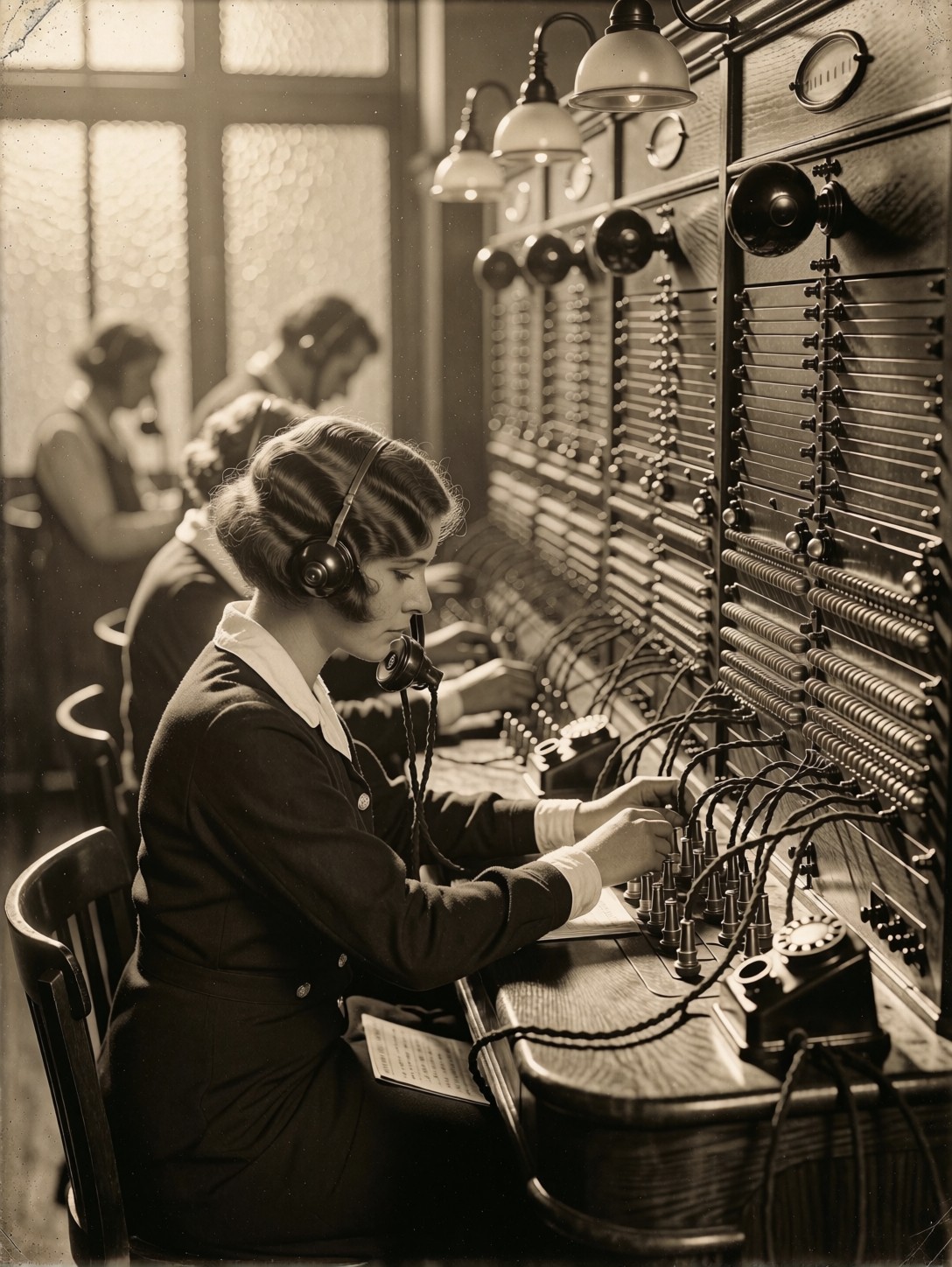
Braided Cords and Brass Sockets: Anatomy of a 1920s Exchange Portrait
A telephone operator buried in her own equipment — jack plugs and braided cords wrapped around her forearms like armor — is the kind of narrative detail that separates a costume portrait from a story. Proxima Aurelia 2 reads the physical tangle as a compositional anchor, letting the chaos of wires frame her forward lean while the marcel-waved bob and white collar keep the era pinned precisely to the 1920s.
The prompt's real trick is depth: rows of brass sockets and blinking indicator lamps recede into a blurred exchange office, colleagues soft-focus behind her, while morning light through frosted glass catches drifting dust. The large-format camera language and 90mm lens cue a shallow, painterly depth of field — muted amber and cream, film grain doing the final aging pass. It feels less like a render and more like a photograph that survived a century in an archive drawer.
Editorial Spreads, Historical Fiction, and Period Branding
Vintage-styled imagery this specific earns its keep in editorial contexts: magazine features on communications history, covers and chapter art for historical fiction set in the interwar years, museum-style exhibit panels, and period branding for cafés or agencies trading on early-20th-century nostalgia.
Stick to portrait or near-square framing — 1080×1440 (3:4) or 1440×1440 (1:1). The vertical composition gives the towering switchboard its scale; a wide crop flattens the receding rows of sockets into a cluttered wall. Avoid pushing this prompt toward sharp digital crispness — the film grain is doing period work, not noise.
Settings for Proxima Aurelia 2 — Letting the Storytelling Breathe
Aurelia 2 is built to extract rich visual narrative from even simple prompts, which means this already-dense description needs restraint on the parameter side rather than more steering.
- CFG / Guidance:
3.0–3.5— enough to hold the sepia palette and era details without crushing the hazy highlights - Steps: 30 for maximum quality; 12 steps is fine while you test framing and light direction
- Resolution:
1080×1440for the native 3:4 portrait;1664×928only if you deliberately reframe as a wide editorial shot
Resist the urge to stack extra style keywords. Aurelia 2's aesthetic engine already delivers the grain-and-glow finish — over-specifying tends to fight the model's own composition instincts.
Six Ways to Rewire the Switchboard Scene
Six Targeted Variations for This 1920s Operator Prompt
- Flip the hour: Change "soft morning light" to "harsh overhead tungsten bulbs, deep shadows" — the mood shifts from hazy calm to late-shift exhaustion, and the amber palette cools toward green-gray
- Shift the era: Swap "1920s" for "1940s wartime" and add "ration-pin uniform, propaganda poster on the wall" — same job, heavier stakes, harder light
- Go wide and cinematic: Add "wide shot, 16:9, full exchange floor, dozens of operators at rows of boards" — trades intimacy for a Busby Berkeley-style symmetry of women and wires
- Change the emotion: Replace "leans forward" with "laughs mid-call, head thrown back" — the hectic shift becomes joyful chaos, and the cords read as kinetic energy
- Push the palette: Change "muted amber and cream" to "cold blue-gray tones, warm brass accents" — a melancholic, almost noir version of the same scene
- Detail close-up: Swap the full portrait for "extreme close-up of hands plugging jacks into brass sockets, operator blurred behind" — a tactile macro shot ideal for texture-heavy editorial layouts
Two Prompts Ready to Generate
Both examples below apply variations directly — tuned for Aurelia 2 at the settings above.
Variation: harsh tungsten, late-shift mood — morning haze replaced by hard overhead light and a heavier, wearier atmosphere
Vintage sepia-toned photograph of a 1940s wartime telephone operator at a towering wooden switchboard, harsh overhead tungsten bulbs casting deep shadows across her face, braided cords tangled around her forearms, marcel-waved bob, dark buttoned uniform, rows of brass sockets receding into a dim exchange office, film grain, muted amber and gray palette, large-format camera, 90mm lens, shallow depth of field, highly detailed, 8k
Variation: tactile close-up — the full portrait becomes a macro shot of hands, jacks, and brass, with the operator as soft-focus context
Vintage sepia-toned close-up photograph of a 1920s telephone operator's hands plugging brass jack plugs into glowing sockets of a wooden switchboard, braided cords coiled around her wrists, operator blurred in soft focus behind, morning light through frosted glass catching dust, film grain, muted amber and cream palette, large-format camera, macro detail, shallow depth of field, highly detailed, 8k
More Vintage Prompts in the Same Mood
If the sepia-and-soft-light treatment works for you, these prompts explore similar period aesthetics — glamour, café life, and ballroom nights:


