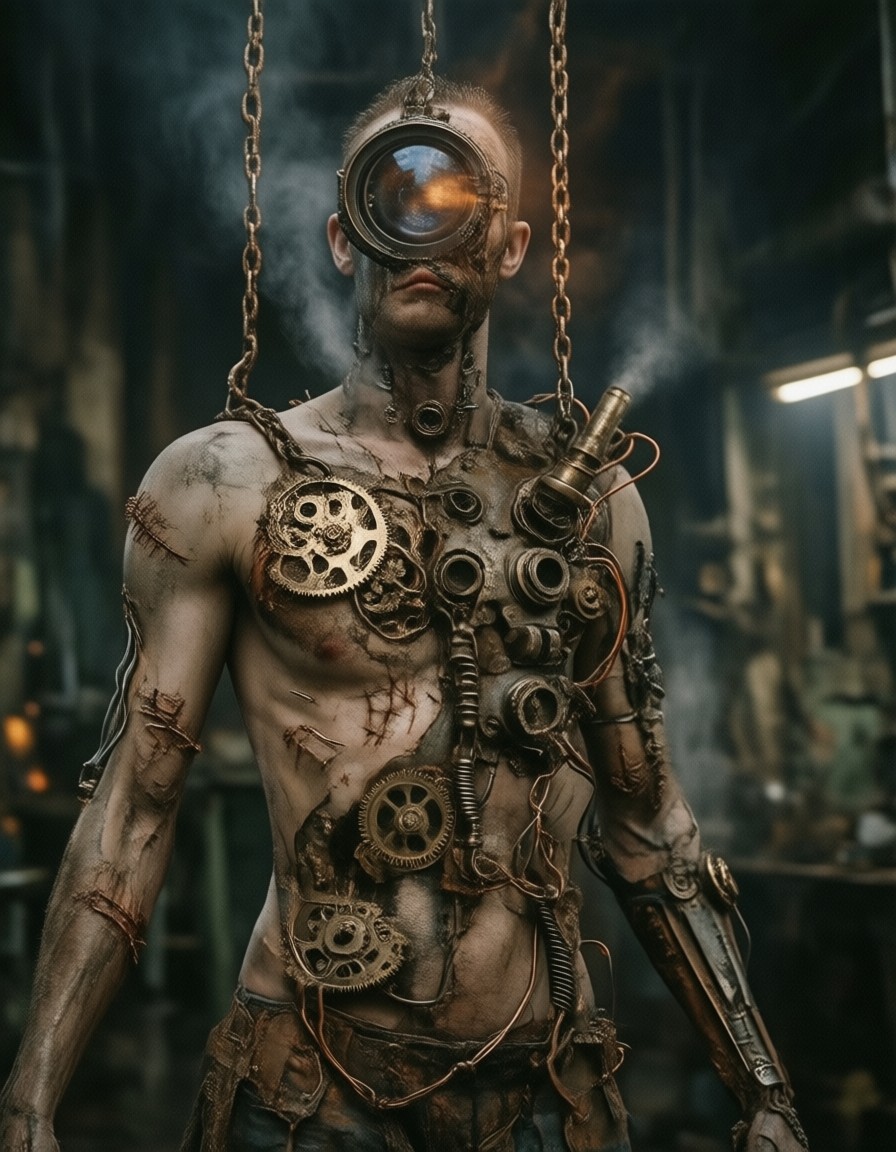


Organic and Machine Collide in a Nightmare of Flesh and Gears
The mechanical lens on this figure’s face is no mere prosthetic — it’s a grotesque fusion of biology and engineering, its cold orange glow illuminating the chaos beneath. Qwen Image 2512 renders the leathery skin and rusted brass gears with clinical precision, making every stitch and piston feel like a wound that never healed. The low-angle shot emphasizes the figure’s dominance over the dark workshop, where steam and shadows conspire to make the scene feel like a fever dream.
This is horror as tactile experience: the textures of rust, flesh, and metal are so vivid they almost smell metallic. The chains binding the figure to the ceiling add to the sense of entrapment, while the hissing pistons suggest a machine that’s never truly dormant.
Concept Art, Horror Game Assets, and Dark Fiction Illustrations
This prompt is tailor-made for creators needing visceral, high-detail body horror imagery. It works exceptionally well for concept art in horror films, video game environments, or dark fantasy novels where the grotesque is a character in itself. The 8k resolution requirement makes it ideal for print or large-scale displays.
For optimal impact, use a **16:9** aspect ratio to frame the full-body shot and industrial workshop without cropping the chains or steam vents. Avoid vertical crops — they’d compress the mechanical details into noise.
Settings for Qwen Image 2512 — Stability Through Precision
Qwen Image 2512 benefits from clear, rewritten prompts to avoid ambiguity. For this nightmare scene, set cfg_scale to 3.0 — too high and the mechanical details may blur into the background; too low and the textures lose definition.
- CFG / Guidance:
3.0— balances mechanical sharpness with atmospheric mood - Steps: 30 for full 8k detail; 12 steps for quick previews
- Resolution:
8192×4320(16:9) — maintains clarity for both the figure and workshop environment
With cfg 3.0 and 30 steps, Qwen Image 2512 will resolve the intricate mechanical lens and hissing pistons without overemphasizing the Horror 1980x LoRA’s nostalgic grain.
Horror 1980x LoRA — Nostalgia as a Weapon
- Horror 1980x at
0.70— adds grainy VHS texture and slasher-film suspense to the mechanical lens, making it feel like a corrupted film reel
Raising the weight to 0.85 will intensify the nostalgic horror, adding flickering shadows and vintage color distortion to the workshop. Lower it to 0.60 if you want the machine’s cold precision to dominate over the horror aesthetic.
Five Ways to Push the Nightmare Further
5 Targeted Variations for This Prompt
- Change the lens: Replace "massive mechanical lens" with "cracked television screen displaying static" — the horror becomes psychological, with the static suggesting trapped consciousness
- Alter the lighting: Change "cold orange light" to "flickering neon blue" — the mood shifts from industrial to cyberpunk, with the mechanical lens becoming a corrupted interface
- Add context: Add "a faded poster of a missing persons notice on the wall" — introduces narrative depth, suggesting this figure is a failed experiment or lost soul
- Reframe the body: Change "deceased human figure" to "alive but tortured human figure" — the chains become restraints, and the workshop feels like a lab rather than a graveyard
- Cultural twist: Replace "industrial workshop" with "Victorian-era anatomist’s lab" — the steampunk becomes more historical, with the machine resembling a 19th-century dissection tool
Two Prompts Ready to Generate
Apply two of the variations above — both are optimized for Qwen Image 2512’s resolution and LoRA compatibility.
Variation: static TV lens — replaces the mechanical lens with a corrupted television screen, intensifying the psychological horror
Nightmare style, Body Horror, a grotesque full-body shot of a deceased human figure integrated with a rusted, complex steampunk machine. The body's skin is pale and leathery, with brass gears, copper wires, and hissing pistons brutally stitched into the chest, limbs, and face. One half of the face is replaced by a cracked television screen displaying static, cold blue light. Steam escapes from small vents in the neck. The figure is suspended by heavy chains in a dark, grimy industrial workshop. Low-angle shot, moody lighting, heavy textures of rust, flesh, and metal, deeply unsettling, 8k resolution.
Variation: Victorian anatomist’s lab — replaces industrial workshop with a 19th-century lab setting, adding historical context to the horror
Nightmare style, Body Horror, a grotesque full-body shot of a deceased human figure integrated with a rusted, complex steampunk machine. The body's skin is pale and leathery, with brass gears, copper wires, and hissing pistons brutally stitched into the chest, limbs, and face. One half of the face is replaced by a massive mechanical lens glowing with cold orange light. Steam escapes from small vents in the neck. The figure is suspended by heavy chains in a dark, grimy Victorian-era anatomist’s lab. Low-angle shot, moody lighting, heavy textures of rust, flesh, and metal, deeply unsettling, 8k resolution.
More Horrific Imagery in This Direction
Other prompts in this category explore similar dark, industrial, and psychological themes with different twists: