
Steam and Neon Reflections: How This Scene Comes Alive
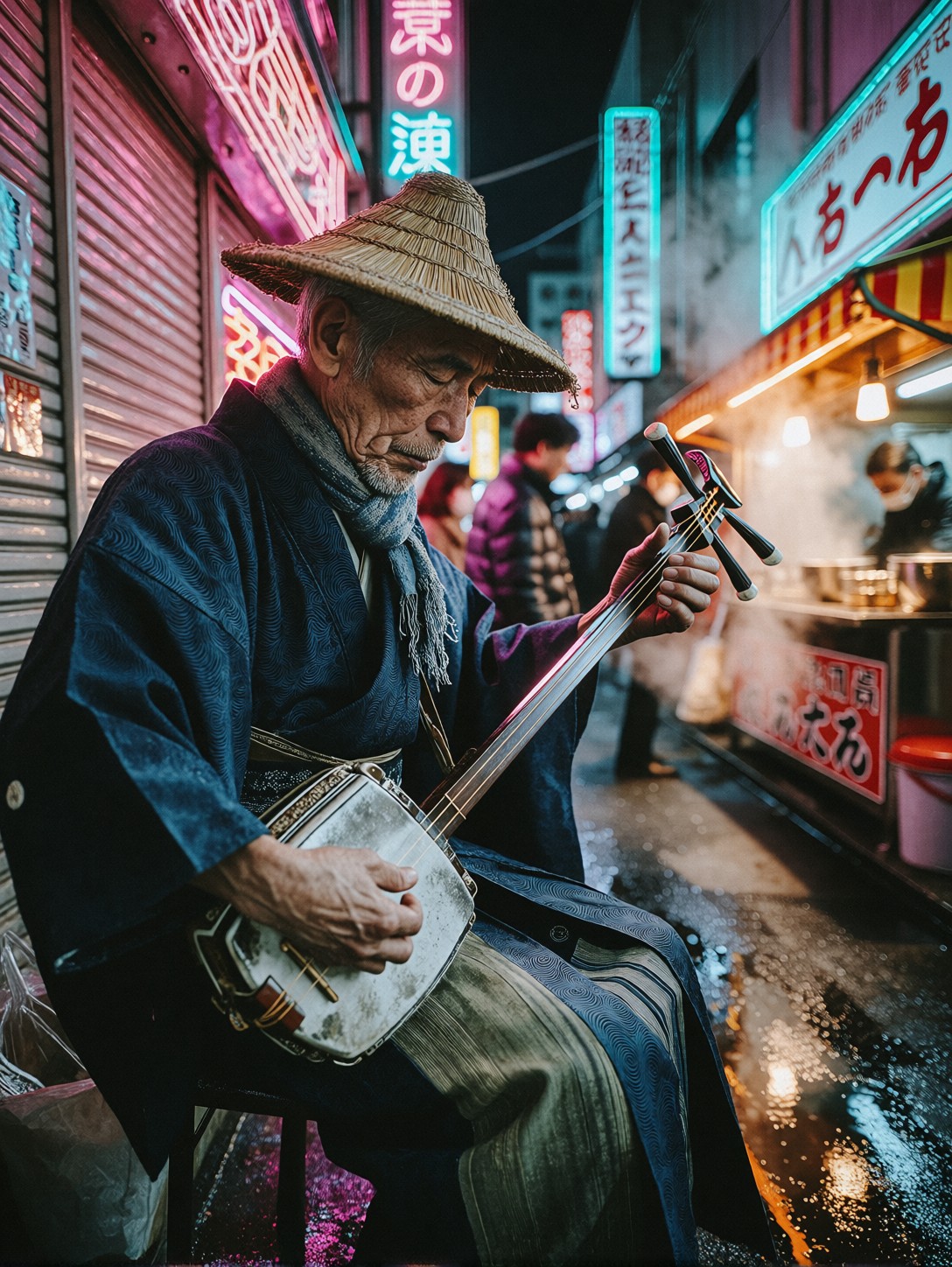
Steam curling from a hidden ramen stall meets the cold glow of cyan and amber neon signs bouncing across rain-slicked Shinjuku asphalt. This composition frames a quiet moment of cultural preservation, not just a portrait. Proxima Aurelia 2 weaves documentary realism with cinematic depth, rendering every wrinkle, age spot, and frayed straw hat brim with tactile authenticity. Shallow depth of field isolates his closed eyes and graceful fingers, turning the shamisen into an extension of breath rather than a prop. Wet pavement reflections act as natural light guides, pulling your gaze toward the instrument while blurred passersby provide just enough urban context. It’s melancholic, intimate, and deeply grounded in lived experience.
Editorial Spreads, Indie Game Assets, and Atmospheric Portraits
Art directors building visual narratives around tradition meeting modernity will find this framing ideal for magazine editorials, indie game environments, or album artwork that demands emotional weight. The vertical composition works beautifully for digital galleries, but switching to 16:9 unlocks the full cinematic scope, letting neon reflections stretch across the frame like a film still. Keep in mind that while Aurelia handles lighting and texture effortlessly, dense overlapping text on background signs may require minor prompt refinement if legibility becomes the goal.
Settings for Proxima Aurelia 2 — Balancing Storytelling and Realism
Aurelia’s latest architecture thrives on atmospheric layering, but it needs precise guidance to avoid over-stylizing the documentary realism at the core of this scene. Start with a true_cfg_scale between 3.0 and 3.5 — higher values will flatten the wet pavement reflections into harsh glare. Set steps to 28–32 so the model can resolve fine fabric weave and skin texture without burning out highlights. For resolution, 1152×1664 (9:16) keeps the portrait intimacy sharp, while 1536×864 (16:9) captures the alleyway’s environmental scale.
The model’s strength lies in intelligent composition and rich visual storytelling. Let the base architecture handle scene geometry first, then layer styling LoRAs to polish the final grade.
Handling the Midjourney-Style Rendering LoRA
- Midjourney-Style Rendering at
0.75places it firmly in the dominant influence range. This pushes the output toward a polished, high-finish cinematic aesthetic, softening harsh digital edges while amplifying color grading and contrast. - If you want to preserve raw documentary grit, drop the LoRA weight to
0.40–0.50. The 70+ range is best when you want that signature polished look to override the base model’s default rendering behavior.
Five Targeted Shifts for the Shinjuku Musician Scene
5 Concrete Variations to Push the Composition Further
- Seasonal atmosphere swap: Replace "wet pavement" and "steam" with "heavy snowfall, frost-coated neon, breath visible in cold air" — the melancholy deepens into isolation, and reflections shift from liquid to crystalline.
- Time-of-day reframe: Change "neon-lit alley at night" to "pre-dawn blue hour, streetlamps flickering off, mist clinging to rooftops" — removes harsh digital glare for a softer, painterly dawn glow.
- Cultural context twist: Swap the shamisen for a traditional koto or taiko drums, and adjust "straw hat" to "traditional geta sandals and haori jacket" — grounds the piece in different regional folk traditions while keeping the documentary tone.
- Perspective shift: Add "over-the-shoulder shot, focus on calloused fingertips pressing strings, background signs heavily bokehed into color orbs" — turns the image from environmental portrait to tactile detail study.
- Action-driven mood: Change "eyes closed in deep emotion" to "looking up at a passing tourist with a wry smile, hand pausing mid-strum" — injects narrative warmth and human connection into the solitary scene.
Two Prompts Ready to Generate
Apply two of the variations above directly — both are tuned for Proxima Aurelia 2 at the recommended settings, with the LoRA weight kept at 0.75 for that signature cinematic polish.
Variation: seasonal atmosphere swap — snow replaces rain, reflections become crystalline, and the scene shifts from urban melancholy to quiet isolation
Cinematic documentary portrait of an elderly Japanese street musician playing a shamisen in a snow-covered Shinjuku alley at dusk. He wears a vintage dark blue kimono with wave patterns, faded scarf, worn straw hat. Fingers move gracefully over strings, eyes closed. Behind him, pink and cyan neon signs cast long shadows across fresh powder snow. Blurred passersby walk past a steamy ramen stall. Intimate, melancholic, authentic skin texture, fabric details, cold cinematic lighting, 8K, shallow depth of field
Variation: perspective shift — over-the-shoulder framing focuses on calloused fingertips and string tension, turning environmental context into abstract color orbs
Over-the-shoulder documentary shot of an elderly Japanese musician playing shamisen in a narrow Shinjuku alley at night. Focus tightly on calloused fingertips pressing silk strings, vintage dark blue kimono sleeve visible. Behind him, blurred pink and amber neon signs reflect off wet pavement, steam rising from a distant ramen stall. Deep emotional focus, cinematic depth, 8K, realistic skin texture, shallow depth of field, melancholic atmosphere
More Atmospheric Character Compositions
If you enjoy blending moody lighting with character-driven storytelling, these compositions explore similar cinematic territories and environmental depth: